Sponsor


Boeing to produce more wideband global SATCOM satellites for US Air Force

January 18, 2012

EL SEGUNDO, Calif., Jan. 18, 2012. Boeing [NYSE: BA] has received authorization from the U.S. Air Force to produce and launch the eighth and ninth Wideband Global SATCOM (WGS) satellites. The WGS-9 authorization and the WGS-8 production option, which was authorized last month, have a combined value of $673 million and are part of the $1.09 billion contract modification announced by the Air Force in September 2011.
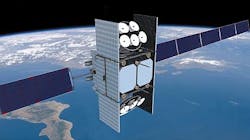

WGS-8 and -9 will join four other satellites that are part of the Block II series. Block II adds a switchable radio frequency bypass that enables the transmission of airborne intelligence, surveillance and reconnaissance imagery at data rates approximately three times greater than the rates available on Block I satellites.


WGS-9 is being funded through a cooperative agreement that the U.S. Air Force has forged with Canada, Denmark, the Netherlands, Luxembourg and New Zealand. This expands the WGS international partnership beyond WGS-6, which was funded by the Australian government in 2008.

WGS satellites are built on the proven Boeing 702HP platform, which features xenon-ion propulsion, deployable thermal radiators, and triple-junction gallium-arsenide solar arrays that enable high-capacity, flexible payloads. The WGS communications payload has unique flexibility that is important to the military, as well as the ability to interconnect terminals that operate in different frequency bands and to reposition coverage beams based on evolving mission needs. WGS supports missions including tactical communications to and between ground forces, and relaying data and imagery from airborne intelligence, surveillance and reconnaissance platforms.


Social Media Tools

Sponsored by:
Recommend this Article Recommend this Article () You Recommended this Article You Recommended this Article ()

REPRINTS: Is your company featured in this article? Click here to purchase reprints.            Go to Home Page


Most Popular Articles

Wire News provided by   

Webcasts

Upcoming

High Performance Embedded Computing for Rugged Mobile Applications

High-performance embedded computing, often referred to as HPEC, is increasing in importance for rugged mobile applications such as land vehicles, unmanned aerial vehicles, unmanned underwater vehicles, and a...
( 06/14/2012 / 02:00 PM EST5EDT / 01:00 PM CST6CDT / 11:00 AM PST8PDT / 06:00 PM GMT )

On Demand

A Deep Look at the Pentagon's 2013 Budget Request for Electronics and Electro-optics Technologies

John Keller, chief editor of Military & Aerospace Electronics, brings his 30-plus years of experience covering the aerospace and defense industry to this interactive webcast.

Mil & Aero Magazine

May 2012
Volume 23, Issue 5

M&AE Article Archives

Close this offer Close
Military & Aerospace Electronics Defense Executive Ebedded Computing Report Avionics Intelligence
Subscribe
FREE Newsletters from the Aerospace & Defense Media Group
Required field
Required field
Required field
I would like to receive the following e-mail newsletters
Military & Aerospace Electronics Weekly Yes No Required field
Defense Executive Yes No Required field
Embedded Computing Report Yes No Required field
Avionics Intelligence Yes No Required field
In order to subscribe, you must select at least one newsletter above.
No Thanks. No Thanks