DOD plans to spend $5.78 billion for unmanned vehicles procurement and research in 2013
WASHINGTON, 14 Feb. 2012. Officials of the U.S. Department of Defense (DOD) plan to spend at least $5.78 billion to buy and develop unmanned vehicles and unmanned vehicle payloads next year, according to data in the Pentagon's budget documents released this week. This figure is down 13.14 percent from the same levels of spending this year, and is down 16.9 percent from unmanned vehicles procurement and research in 2011.
The military services and Pentagon agencies plan to spend $4.14 billion on unmanned vehicle procurement and $1.63 billion on unmanned vehicle research, development, test, and evaluation (RDT&E) in fiscal 2013, which begins next Oct. 1.
Among the most notable changes contained in the Pentagon's unmanned vehicles budget request for next is termination of the Northrop Grumman Block 30 version of the Global Hawk unmanned aerial vehicle (UAV), which Pentagon officials contend is no longer cost-effective. Instead, military leaders plan to use manned reconnaissance aircraft -- primarily the U-2 high-altitude jet -- to fulfill the terminate Global Hawk Block 30 mission.
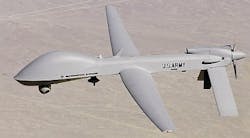
DOD officials plan to buy at least 690 unmanned vehicles next year, including a planned $111.65 million U.S. Army buy of 339 unmanned ground vehicles (UGVs), a planned $769.88 million Army buy of 40 General Atomics MQ-1 Reaper weaponized UAVs, a $25.8 million Army purchase of 234 RQ-11 Raven UAVs, a $786.79 million U.S. Navy buy of 19 InSitu Small Tactical Unmanned Air System (STUAS) unmanned aircraft, a $314.22 million U.S. Air Force buy of four MQ-9 Reaper UAVs, and a $217.24 million U.S. Special Operations Command purchase of one AeroVironment RQ-11 Raven UAV.
Other unmanned vehicle-related DOD procurement planned for next year includes a $271.98 million Army purchase of 34 MQ-1 UAV payloads, an $83.34 million Army project to modify the AAI RQ-7 Shadow UAV, a $79.25 million Air Force plan to modify the MQ-9 UAV with new payloads, and a $682 million project to support the Northrop Grumman MQ-8 Fire Scout unmanned helicopter.
One of the largest unmanned vehicles-related research and development projects next year involves a $657.48 million Navy plan to support the Northrop Grumman RQ-4 large UAV. The Navy is developing this version of the Global Hawk for long-range oceanic surveillance and anti-submarine warfare. This version of the Navy RQ-4 is called the Broad Area Maritime Surveillance (BAMS) system.
The Air Force also has a $236.27 million research project in the works involving the RQ-4 UAV platform, as well as a $148 million research project involving the MQ-9 UAV.
Other notable unmanned vehicles research on tap in 2013 includes a $26.2 million Army project for long-endurance UAV research, a $76.62 million research project involving the MQ-1 Grey Eagle armed UAV, a $122.48 million Navy research program to develop the Unmanned Carrier Launched Airborne Surveillance and Strike (UCLASS) system, and a $142.28 million Navy research project to develop the Unmanned Combat Air Vehicle (UCAV) Advanced Component and Prototype.
