NASA struggles to overhaul 20-year-old flight-control computers on Black Hawk research helicopter
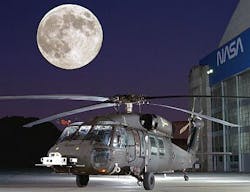
MOUNTAIN VIEW, Calif., 29 June 2012. Advanced helicopter avionics researchers at NASA are reaching out to industry to find experts who could diagnose, repair, or rebuild components of a troublesome 20-year-old experimental flight-control computer designed originally to help develop and test military helicopter flight-control concepts.
Officials of the National Aeronautics and Space Administration (NASA) Ames Research Center in Mountain View, Calif., issued a request for information (NNA12440683L) last week to find anyone in industry who could fix or remanufacture I/O processor circuit cards for the Research Flight Control Computer Assembly (RFCCA) aboard the NASA Sikorsky JUH-60 Rotorcraft Aircrew Systems Concepts Airborne Laboratory (RASCAL) helicopter (story continues below).
NASA Ames bought the RFCCA research flight-control computer from the Boeing Defense and Space Group's Helicopters Division and Lear Astronics Corp. back in the 1990s. The airborne computer is designed to 1990s-era standards for production military helicopter flight control electronics.
Today the U.S. government and NASA own the RFCCA's design, and have schematics of the major circuit cards, but detailed documentation such as Gerber files and bill of materials for the I/O processor cards have been lost. NASA avionics experts say some reverse engineering may be necessary.
NASA Ames has two functional RFCCA units and one qualification test unit. Although one RFCCA works just fine, the other has intermittent I/O processor card malfunctions. The qualification unit, meanwhile, doesn't work at all.
NASA has had the JUH-60 RASCAL research helicopter since 1989 to handle helicopter stability, control, and guidance system research. The rotorcraft is among the most sophisticated variable stability helicopters ever developed by NASA and the U.S. Army.
The RASCAL helicopter helps develop technologies to improve the agility of military helicopters, while also providing the pilot with care-free maneuvering inside an automatically protected flight envelope.
Part of the RASCAL helicopter is its advanced 32-bit Research Flight Control System (RFCS) developed by Boeing, which houses the RFCCA I/O processor cards. NASA avionics experts say they expect to solve the RFCA's problems in two phases.
First, NASA officials want a contractor to review the RFCCA existing design data, identify and document I/O processor card malfunctions, do reverse engineering as necessary, and come up with a plan to repair or rebuild the cards. Second, the contractor selected would repair or rebuild several I/O processor cards.
Of particular interest to NASA is finding non-invasive and invasive inspection techniques to diagnose the source of I/O processor circuit board malfunctions, and other kinds of test equipment to do this job.
Companies interested taking this avionics-overhaul job on should respond by e-mail no later than 15 July 2012 to NASA's contracting officer, Patricia Williams at [email protected]. Responses should be no longer than 10 pages.
For questions or concerns, phone Williams at 650-604-3896 or Marianne Shelley at 650-604-4179. More information is online at https://www.fbo.gov/spg/NASA/ARC/OPDC20220/NNA12440683L/listing.html.
Follow Military & Aerospace Electronics and Avionics Intelligence news updates on Twitter
