Navy asks Raytheon to push forward with project to convert UAV control station software from Solaris to Linux
PATUXENT RIVER NAS, Md., 14 June 2012. Software engineers at the Raytheon Co. Intelligence and Information Systems segment in Garland, Texas, will continue a project to convert application code in the U.S. Navy Tactical Control System (TCS) for unmanned aerial vehicles (UAVs) from the proprietary Solaris operating system to the open-systems Linux operating system under terms of a $27.9 million contract awarded last week.
Officials of the Naval Air Systems Command at Patuxent River Naval Air Station, Md., announced the contract to Raytheon Intelligence and Information Systems in a contract justification-and-approval document released on 7 June. Navy officials say Raytheon is the only responsible source able to do the UAV control station software upgrade (story continues below).
The contract and contract modifications to Raytheon concern the TCS interfaces to the Northrop Grumman MQ-8 Fire Scout vertical takeoff and landing unmanned aerial vehicle (VTUAV), which help human operators control the aircraft and its payloads during sea- and ground-based operations.
The Raytheon TCS is designed to operate UAVs in all branches of the U.S. military, as well as NATO STANAG 4586-compliant UAVs. Raytheon developed the TCS to run on the Sun Microsystems Solaris 8 software operating system, which is approaching the end of its useful life in U.S. military applications.
The contract calls for Raytheon to convert TCS software that runs the Fire Scout to the open-source Linux operating system. The Solaris and Linux operating systems both are based on the Unix operating system.
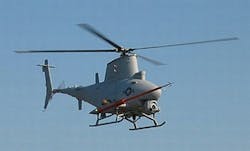
The MQ-8B Fire Scout from the Northrop Grumman Corp. Aerospace systems segment in Redondo Beach, Calif., is an unmanned helicopter for Navy situational awareness and precision targeting. The unmanned aircraft is based on the Schweizer Model 333 two-seat manned helicopter from Schweizer Aircraft Corp. in Horseheads, N.Y. It can autonomously take off and land on any aviation-capable warship and at unprepared landing zones near battlefields.
Story continues below the videoThe Navy and Northrop Grumman are working together to upgrade the Fire Scout UAV to extend the aircraft's endurance. Northrop Grumman won a $262.3 million contract in April to build two unmanned helicopters and six fire Scout UAVs as part of the vertical take-off and landing tactical unmanned aerial vehicle (VTUAV) endurance upgrade rapid deployment capability.
The TCS can be configured in racks for ship-based operations, shelterized as a land-based system, or integrated into a shelter on land vehicles such as the HMMWV. TCS is the Navy's UAV ground-control station for the VTUAV program as an associate contractor to Northrop Grumman.
There are five levels of TCS functionality. levels I and II enable receipt of imagery. levels III and IV provide command and control of the air vehicle and payload and imagery receipt. level V provides command-and-control, payload control, imagery receipt, and the ability to take off and land.
For more information contact Raytheon Intelligence and Information Systems online at www.raytheon.com/businesses/riis, Northrop Grumman Aerospace Systems at www.as.northropgrumman.com, or Naval Air Systems Command at www.navair.navy.mil.
Follow Military & Aerospace Electronics and Avionics Intelligence news updates on Twitter
