Small-form-factor 96-line digital I/O embedded computing module for high-speed interfacing introduced by WinSystems
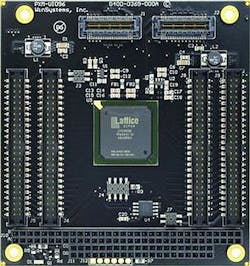
ARLINGTON, Texas, 19 Aug. 2012. WinSystems Inc. in Arlington, Texas, is introducing the PXM-UIO96-2 SUMIT-ISM compatible small-form-factor 96-line digital I/O embedded computing module for high-speed interfacing. The I/O module offers PCI Express expansion on a 90-by-96-millimeter PC/104-sized module enabled by the stackable high-speed SUMIT connector.
The card can monitor all 96 lines for both rising and falling digital edge transitions, latch them, and then interrupt the host processor notifying it that a change-of-input status has occurred. This is an efficient way of sensing and signaling the CPU of real-time events without the burden of continuous polling of the digital I/O points.
The PXM-UIO96-2 uses a Lattice Semiconductor ECP2M family FPGA with a superset of two WinSystems WS16C48 Universal I/O controller cores. It is wired to the PCI Express x1 lane of the SUMIT-A connector and automatically selects the first available link.
Each I/O line is programmable for input, output, or output with read-back operation. Transition polarity is programmable and enabled on a bit-by-bit basis. Each line's transition is latched so that even short duration pulses will be recognized.
Each output channel is latched and has an open collector driver with a pull-up resistor capable of sinking 12 milliamps of current to enable direct interface with optically isolated digital signal conditioning modules.
The PXM-UIO96-2 supports Linux, Windows, and other x86-compatible real-time operating systems. Free drivers are available. This board will operate in temperatures from -40 to 85 degrees Celsius, and is RoHS compliant.
The PXM-UIO96-2 includes the SUMIT (Stackable Unified Module Interconnect Technology) connector that was developed and standardized by the Small Form Factor Special Interest Group (SFF-SIG: www.sff-sig.org). SUMIT is an electromechanical connectorization specification that enables stacking of common serial and legacy chipset expansion buses on PC/104 and other form factor's I/O modules for next generation embedded systems products.
For more information contact WinSystems online at www.winsystems.com.
Follow Military & Aerospace Electronics and Avionics Intelligence news updates on Twitter
