Embedded thermal management from Mercury increases cooling from 15 to 50 Watts per mezzanine site
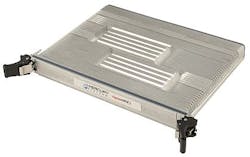
CHELMSFORD, Mass., 28 Dec. 2012. Mercury Systems Inc. in Chelmsford, Mass., is introducing a thermal-management approach for air- and conduction-cooled embedded computing mezzanine cards that places a cold plate on the carrier module to achieve new levels of electronics cooling.
The Mercury Systems (NASDAQ:MRCY,) thermal-management approach is for air-cooled, conduction-cooled and VITA 48 subsystem chassis in high-powered radar, electro-optical, signals intelligence, and electronic warfare EW applications on ground vehicles and aircraft.
"Our thermal-management solutions are capable of dissipating tremendous amounts of thermal energy, while still meeting the same or smaller size, weight and power requirements for the overall solution," says Darryl McKenney, vice president of Mercury's engineering services team.
Mercury's XMC air-cooled design draws heat away from today's high-powered mezzanine cards, then onto the carrier module and ultimately out of the system. Hooks that connect to a thermal bridge between the card and module can reduce mezzanine card temperatures by more than five degrees Celsius while complying with the VITA 48.1 mechanical specification for air cooling.
The conduction-cooling approach removes the optional thermal ribs and adds a mezzanine cold plate that attaches to the carrier module. This creates a cooling area that is as much as six times larger than the area of the legacy solution, and increases cooling from 15 to 50 Watts per mezzanine site.
Mercury's Air Flow-By cooling for VITA 48.7/48.1 circuit card assemblies reduce module weight by more than 20 percent, reduce the power of a typical system by greater than five percent, and improve mean time between failures by five times, company officials say.
The Air Flow-By covers wrap around existing modules to protect against dust and contaminants. The covers also facilitate level-2 maintenance (L2M) and EMI shielding; the cover acts as an electrical Faraday cage.
The cover draw heat from the internal components to the exterior surface, where air flows across both sides of the module for cooling. Air Flow-By modules are in 1-inch pitch and provide more than 200 Watts per-slot of 6U cooling capacity.
For more information contact Mercury Systems online at http://mrcy.com.