Raytheon to provide networked sensor processing for newest Burke-class destroyer
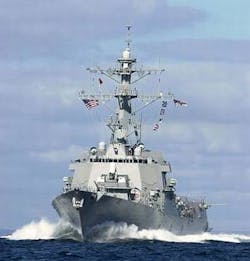
WASHINGTON, 18 Jan. 2013. U.S. Navy officials needed a networked sensors and weapons-management system for the future Arleigh Burke-class guided missile destroyer USS Thomas Hudner (DDG-116), the first of the Flight IIA: Technology Insertion versions of the destroyer. They found their solution from the Raytheon Co. Network Centric Systems segment in St. Petersburg, Fla.
The Naval Sea Systems Command in Washington awarded a $20.3 million contract to Raytheon this month to provide an AN/USG cooperative engagement transmission processing set, a key component in the Raytheon Cooperative Engagement Capability (CEC) network-centric sensors and weapons system for Navy surface warships. The latest version of the AN/USG processing set is the AN/USG-2(V).
The Hudner, which should be commissioned in about 2021, is to be the 66th ship of the Arleigh Burke class of destroyers for anti-aircraft, anti-submarine, and anti-surface warfare, as well as strike operations. The ship was ordered early last year from General Dynamics Bath Iron Works in Bath, Maine.
The Hudner is to be a technology-insertion ship with elements of the next generation of Arleigh Burke class destroyers, called Flight III, and Flight III proper is planned to start with DDG-122.
The CEC system conducts air and missile defense by distributing sensor and weapons data by fusing high quality tracking data from participating sensors and distributes it to all other participants to create one common air defense picture based on all sensor data available. This ability enables early target detection and consistent tracking of air contacts. At the heart of the CEC is a communications system.
CEC distributes radar measurement data instead of actual tracks from each CEC unit to all other CEC units, which communicate in pairs during short transmit and receive periods through a narrow directional signal. Data flows across the network in near real time and communication is virtually jam-proof, experts say.
CEC units are able to engage using CEC composite tracks, even when the firing unit does not hold the track. Because CEC combines radar measurement data from all of the ships and aircraft on the network, the CEC picture covers a larger geographic area than any one sensor can, and enhances radar coverage over land.
In theater ballistic missile defense, the CEC provides a continuous fire-control quality track on the incoming missile. Although each ship is able only to maintain track for part of the missile flight, the CEC composite track, based on all the data, is continuous.
Ships operating without CEC must spread their radar energy widely, which limits the time and energy available to search in the difficult land clutter region. Operating together, with CEC, one ship can search the entire volume while the other ships concentrate on the land clutter region.
The AN/USG-2 -- also known as the Cooperative Engagement Transmission Processing Set (CETPS) -- coordinates all task force anti-air warfare (AAW) sensors into one real time, fire control quality composite track picture by distributing sensor data from each cooperating unit to all other cooperating units via a real time line of sight fire control sensor and engagement data distribution network.
The AN/USG CETPS resists the effects of electronic jamming and provides accurate gridlocking between CEC cooperating units. Each cooperating unit independently combines all the distributed sensor data into a common track picture with high capacity, parallel processing and advanced algorithms. The resulting composite track picture is the same on all cooperating units.
The CETPS consists of cooperative sensing, engagement decision, engagement execution and data distribution, and enables all anti-air warfare sensors and weapons in a battle group to function as one distributed system.
The CETPS also enables several battle groups to conduct network-centric operations by sharing common picture and tactical capabilities.
The CETPS is composed of two primary system groups and five subsystem functions. The two primary system groups are the Data Distribution System (DDS) and Cooperative Engagement Processor (CEP). The five subsystem functions are the data distribution, command/display support, sensor cooperation, engagement decision, and engagement execution.
For more information contact Raytheon Network Centric Systems online at www.raytheon.com/businesses/ncs, or Naval Sea Systems Command at www.navsea.navy.mil.
