DARPA releases solicitation for ICECool thermal-management program for embedded computing
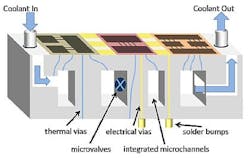
ARLINGTON, Va., 8 Feb. 2013. Military researchers released a formal industry solicitation Wednesday for a major new initiative to demonstrate advanced electronics cooling techniques for high-performance embedded computing (HPEC) and RF monolithic microwave integrated circuit (MMIC) power amplifiers with convective or evaporative microfluidic cooling built directly into the electronic devices and packaging.
Microelectronics scientists at the U.S. Defense Advanced Research Projects Agency in Arlington, Va., released a broad agency announcement (DARPA-BAA-13-21) for the Intrachip/Interchip Enhanced Cooling Applications (ICECool Applications) program to explore disruptive thermal technologies to break through thermal limitations in military electronics and size, weight, and power consumption (SWaP) in military embedded systems and RF MMICs.
The specific goal of ICECool Applications is to enhance the performance of RF power amplifiers and embedded computing by removing one kilowatt per square centimeter heat flux, as well as one kilowatt per cubic centimeter heat density in high-performance embedded computing boards and RF MMICs.
Essentially, DARPA scientists want to make cooling just as important as any other aspect of chip design, and use embedded thermal management to enhance the performance of military electronics. Integrating chips with convective or evaporative microfluidic cooling, DARPA officials say, has the potential to speed the evolution of advanced chip integration.
ICECool Applications will be a 30-month effort, and will be the second BAA of DARPA’s ICECool program. DARPA briefed industry on the program this week on Thursday.
DARPA released a broad agency announcement (DARPA-BAA-12-50) last summer for the first phase of the ICECool program, called ICECool Fundamentals, which is exploring revolutionary thermal-management technologies for military electronics to help designers make substantial reductions in size, weight, and power consumption (SWaP).
One fundamental problem that electronic systems designers have today is the large size and weight of cooling subsystems. Ever-smaller chip geometries generate increasing amounts of heat, and the ability to cool electronics is moving more slowly than the ability to shrink chip densities.
This causes some advanced electronics to perform well below the inherent electrical limits of the device technology. Integrating cooling directly into the chip could transform electronic systems architectures and overcome the SWaP bottleneck in advanced electronics, DARPA officials say.
The ICECool program will complement other DARPA thermal-management initiatives, such as the Thermal Ground Plane (TGP) program to develop modern high-performance heat spreaders to replace the copper alloy spreaders in conventional systems; the Microtechnologies for Air Cooled Exchangers (MACE) program to develop enhanced heatsinks that reduce the thermal resistance and power requirements for cooling fans; and the Active Cooling Module (ACM) program to develop miniature, active, high-efficiency refrigeration systems based on thermoelectric or vapor-compression technologies.
For the ICECool Applications, DARPA officials say they expect to award contracts to several companies. Those interested in bidding should respond no later than 22 March 2013. The DARPA ICECool Applications program manager is Dr. Avram Bar-Cohen.
E-mail questions or concerns to [email protected]. All requests must include the name, email address, and phone number of a point of contact.
More information is online at https://www.fbo.gov/spg/ODA/DARPA/CMO/DARPA-BAA-13-21/listing.html.
