Army unveils new SIGINT electronics
by John McHale
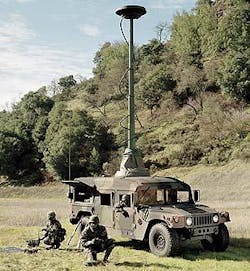
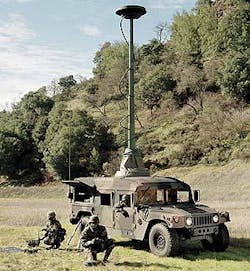
WASHINGTON — U.S. Army leaders are rolling out their newest signals-intelligence system, called Prophet, which disrupts enemy command and control, detects and classifies moving targets, and offers situational awareness on the battlefield, Army officials say.
Prophet detects, demodulates, determines lines of bearing, and exploits enemy signals of interest.
Prophet Block 1, from Titan Systems Corp. in San Diego, is the first new signals-intelligence system in nearly 20 years, says Col. Kevin Peterson, Army Training and Doctrine Command (TRADOC) system manager for the Prophet at Fort Huachuca, Ariz. It is for echelons of division and below.
Prophet already is part of U.S. operations in Afghanistan, said Lt. Gen. Robert Noonan Jr., Deputy Chief of Staff, G-2, during the Prophet rollout last month in Washington, which coincided with the Army's 227th anniversary. Army leaders would not elaborate on Prophet' role in Afghanistan for security reasons.
Prophet, a project of the Program Executive Office for Intelligence, Electronic Warfare and Sensors (IEWS) at Fort Monmouth, N.J., intercepts and locates radio signals while operating on the move; it measures seismic and acoustic changes in the infrared energy, electro-optic, and magnetic fields.
Prophet Block I has an AN/PRD-13(V)2 signal intercept system mounted on a High Mobility Multipurpose Wheeled Vehicle or HMMWV, yet is not a significant target on the battlefield because it has no unique signature, Army officials say; anti-jam capability will be part of the next Block, Peterson says.
Prophet information will flow into the joint net over division communications using a digital link, as well as near continuous voice communications with the maneuver brigade's operations and intelligence elements. Prophet replaces the TRAILBLAZER, TEAMMATE, TRAFFICJAM, and MANPACK legacy systems, Army officials say.
Titan engineers reduced the number of moving parts and improved ease of maintenance, says Lt. Col. William Stevenson, product manager for Prophet at IEWS at Fort Monmouth. Inside the Prophet vehicle the operator uses a Toughbook 28 from Panasonic Personal Computer Co. of Secaucus, N.J., to monitor the incoming intelligence.
Prophet electronics is about 30 to 40 percent commercial-off-the-shelf, or COTS, with most of that lying in the computer hardware, says Ronald Gorda, president of Titan Systems Corp.'s Information Product Group. The simple Prophet design and Windows-based software eases personnel training, Stevenson says.
Titan was to deliver the first six Block 1 systems in June; overall, Army officials say they will field 83 Prophet Block I systems by the end of 2004.
Prophet's receiver/processor — the core electronics of Block I — has three receivers, one direction finder and two monitors, which can operate in search (channel scan) and monitor (fix-tuned) modes. In addition, the DF receiver provides general search (band sweep), DF operations and panning operations (manually tuning a signal).
The system demodulates and collects AM, FM, continuous wave, and single sideband radio signals in the HF, VHF, and UHF spectra.
The Prophet intercept receiver can also be configured to operate as a 32-pound manpack system for airborne or air assault operations, Army officials say. An onboard Precision Lightweight Global Positioning System Receiver and KVH Tactical Navigation system interfaces with Prophet to provide accurate worldwide self-positioning locational data to within 10 meters and a north-sensing device to indicate vehicle heading. Manpack Prophet is self-sustaining for 72 hours.
The AN/VRC-92A Single Channel Ground and Airborne Radio System (SINCGARS) provides Prophet with secure voice communications, Army officials say. Future versions will integrate the Joint Tactical Radio System, Peterson says.
Prophet Block II/III will expand the frequency range and signal types to low-probability-of-intercept and modern signals, as well as include an integrated electronic attack capability. It also will include system netting, signal remoting and beyond-line-of-sight communications.
Prophet Block IV will add mobile-attended platform-based sensors along with unattended ground sensors (UGS) deployed as a distributed and networked multiple-sensor array. Prophet Block V is the last block and will integrate micro-sensors and robotic platforms.
