Budget detailed for Pentagon's $87 billion plan to rebuild arsenal
By Ben Ames
WASHINGTON — U.S. contractors are preparing to fill orders in response to the Bush Administration's request for $87 billion for rebuilding infrastructure, replenishing military stockpiles, and countering terrorism in Afghanistan and Iraq.
Planners at the U.S. Department of Defense (DOD) say they need to replace equipment destroyed in Iraq, including an M109 Paladin howitzer, a Multiple Launch Rocket System launcher, Light Armored Vehicles, medical supplies, and airplane decoys. DOD leaders presumably also need to restock their arsenal of bombs, missiles, and other munitions expended in Middle East military operations, but those details are still classified.
Altogether, the bill for new equipment comes to about $5.5 billion, according to a report from the White House Office of Management and Budget (OMB). If Congress approves it, the money would flow as a supplemental grant to the budget for federal fiscal year 2004, which began Oct. 1.
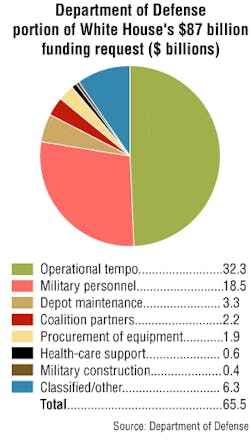
Under the president's original request, the DOD would claim $65.5 billion of the total, says Marine Corps Lt. Col. Rose-Ann Lynch, a Pentagon spokeswoman. Of that $65.5 billion total, $32.3 billion is for maintaining "operational tempo," a catchall phrase that includes wages, gasoline, and base construction; $18.5 billion is for military personnel costs; $13 billion is for military construction, maintenance, military health care support, classified activities, and equipment procurement. Included in this amount is $5.5 billion for weapons systems.
The remainder would go to the U.S. Department of State to help Iraq and Afghanistan return to self-government and rebuild their infrastructures and economies. It also includes $50 million in rewards for the capture of Osama bin Laden and Saddam Hussein.
OMB Director Joshua Bolten detailed the Pentagon's shopping list in a Sept. 17 letter to the president. It includes:
- $435 million for defensewide procurement;
- $265.8 million for defensewide research, development, test and evaluation;
- $3.4 billion for general Air Force procurement
- $40.9 million for Air Force aircraft procurement;
- $39 million for classified Air Force research, development, test and evaluation;
- $20.5 million for Air Force missile procurement;
- $930.7 million for general Army procurement;
- $46 million for Army procurement of weapons and tracked combat vehicles;
- $6.2 million for Army missile procurement;
- $76.4 million for general Navy procurement;
- $128.6 million for Navy aircraft procurement;
- $34 million for classified Navy research, development, test and evaluation;
- $123.4 million for general Marine Corps procurement; and
- $16 million for Marine Corps operations and maintenance.
Defensewide procurement includes specific Special Operations Command, Chemical Biological Defense Program, as well as communications and intelligence efforts. Money would support aircraft modifications ($21.5 million), command, control, communications, computers, and intelligence (C4I) equipment ($36.6 million), ammunition ($23.9 million), soldier equipment ($23.8 million). In addition, the request includes funding for Special Operations Forces (SOF) intelligence systems ($15.8 million), and equipment ($14.8 million). The money also would help improve communications and computer security ($45.4 million), intelligence systems ($34.1 million), and chemical and biological defense equipment ($25.5 million). The remaining $193.6 million is classified.
General Air Force procurement includes improved theater communications systems and components ($150.3 million); logistics and support equipment ($89 million); medical equipment ($13.7 million); replacement vehicles ($39.6 million); equipment for the deployed civil engineers ($25.9 million); and explosive ordnance disposal systems ($1.5 million). The remaining $3 billion is classified.
null
Air Force aircraft procurement includes Air Launched Expendable Decoys ($35.7 million) and Aircraft Common Support Equipment ($5.3 million) to replace combat expenditures in support of Operation Iraqi Freedom. Air Force missile procurement includes Hellfire missiles for the Predator Unmanned Aerial Vehicle, as well as classified activities.
General Army procurement includes logistic support equipment ($30.5 million) and command and control equipment ($42.2 million) destroyed during the war in Iraq; armored Humvees ($177.2 million); improved equipment for active and reserve forces deploying to Iraq ($246.2 million); housing units ($344.7 million); x-ray mobile search devices ($12.6 million); improved communications and intelligence ($17.5 million); improved logistics tracking ($3.4 million); joint tactical terminals ($41.1 million); and robotic counter-sniper systems ($5 million).
Army weapons and tracked combat vehicles procurement includes a replacement M109 Paladin self-propelled howitzer system ($2.4 million) destroyed during the war with Iraq, and vehicle modifications such as gun mounts, gun sights, and rails ($43.6 million). Army missile procurement includes replacing a Multiple Launch Rocket System launcher destroyed in Operation Iraqi Freedom.
General Navy procurement includes spare parts for ships ($27.2 million), command and control improvements ($5.8 million), explosive ordnance equipment ($25 million), hospital equipment damaged or destroyed during the war in Iraq ($13.2 million), and Global Broadcast System terminal improvements ($4.5 million).
Navy aircraft procurement includes additional aircraft spare parts ($59.1 million); replacing outer wing panels for the EA-6B Prowler electronic warfare jet ($55 million) and E-2C Hawkeye radar surveillance aircraft ($1.5 million); and additional F/A-18 Hornet jet fighter bomber support equipment ($13 million).
General Marine Corps procurement includes replacing M882A2 Recovery Vehicles, MK48 Logistics Vehicle Systems ($21.4 million), and Light Armored Vehicles ($23.2 million) destroyed during the war in Iraq, and upgrades to the Advanced Amphibious Assault Vehicles ($78.8 million). Marine Corps operations and maintenance includes anti-terrorism and force protection materials and supplies.
