Ramix Ethernet devices replace FDDI on Navy programs
by John McHale
VENTURA, Calif. — Engineers at Ramix are designing Switched Ethernet devices to replace FDDI (fiber distributed data interface) technology in various U.S. Navy programs.
Navy officials want to replace FDDI devices because many suppliers have "end of lifed their products" and finding new FDDI products can be quite costly, says Saeed Karamooz, president and chief executive officer of Ramix. Ramix's Ethernet solutions have the same bandwidth 10 or 100 megabits per second as the FDDI products but are much less expensive, are available right off the shelf, and use the existing fiber plant installed for FDDI, he adds.
null
The cost of an obsoleted FDDI part is anywhere from $3,000 to $6,000 while the Ramix device is around $1,300, Karamooz says. The Ramix devices used by the Navy are the PMC675 — Intelligent Dual 100-Base Ethernet PMC Module — and the RM939 — 6/18 port Managed VME Switch, he says.
Karamooz declined to comment on specific Navy programs due to contractual obligations.
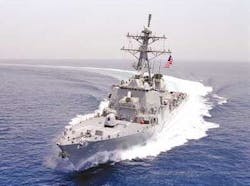
FDDI devices are commonly used in Arleigh Burke-class destroyers as part of the Aegis system. The technology serves as a network interface for the AN/UYQ-70 (Q-70) Advanced Display System designed by Lockheed Martin, in Eagan, Minn.
Q-70 is a flexible, modular, open computer and display architecture design which supports the common operating environment being implemented today in surface, subsurface, land, and airborne platforms. This tactical workstation is configured using high-performance commercial-off-the-shelf modules housed in militarized enclosures. The Q-70 can be installed in airborne, surface, and submarine platforms to fulfill multiple combat system tasks, Lockheed Martin officials say.
"The combination of tried and tested Ethernet technology combined with very robust, relatively low-cost" hardware and software with a low recovery time make this a compelling strategy, particularly as it can be deployed today without risk, says Kim Barnhill, manager of strategic sales and marketing at Ramix.
FDDI was developed in the 1980s, by the American National Standards Institute (ANSI) as the next generation networking technology, Barnhill says.
"Ethernet switching technology is key to FDDI replacement because it offers a far more deterministic environment than a shared media or a collapsed backbone Ethernet hub," Barnhill says. "Both standard collision domain Ethernet and collapsed backbone hubs provide extremely variable packet transit times since resources are shared between all the connected devices."
Switched Ethernet provides a deterministic high throughput infrastructure for replacing FDDI, however additional hardware is required to achieve the high levels of redundancy of FDDI, Barnhill says. Intelligent network interface cards bring home the redundancy through the use of embedded link monitoring software that monitors and manages the dual interfaces, he explains.
Replacing legacy mission-critical FDDI networks with 10.100 or Gigabit Ethernet is a viable and proven proposition, " Barnhill says.
For more information on Ramix contact the company by phone at 805-650-2111 or on the World Wide Web at http://www.ramix.com.
