Laser tracker fits the bill for helicopter augmented-reality system
By John Keller
BURLINGTON, Vt. — The laserBIRD tracker from Ascension Technology in Burlington, Vt., is the foundation of a helicopter-based augmented-reality night-vision system developed in partnership at QinetiQ in Farnborough, England, and the National Research Council of Canada's Institute for Aerospace Research (NRC-IAR) in Ottawa.
The helicopter night-vision system is part of NRC-IAR's research into how augmented-reality displays can expand the utility of helicopters in smoke, haze, bad weather, and at night.
"We're looking at augmented reality to improve the safety and capability of helicopter crews in night operations," says Sion Jennings, a research officer with NCR-IAR.
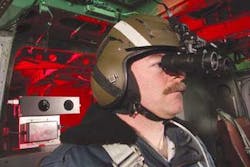
The laserBIRD tracker mounts on the pilot's helmet and superimposes flight symbology wherever the pilot looks. The tracker is crucial in this process to track the motion of the pilot's head to put the symbology in the right places.
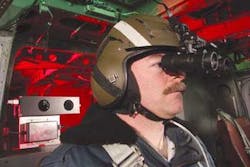
Pilots have used this system to land a Bell helicopter by following a computer-generated path to the landing zone. Motion tracking has been particularly difficult for helicopters, Jennings explains.
The G forces and vibration of the helicopter makes a physical link of mechanical trackers to the helicopter difficult, while magnetic trackers have difficulty with metallic interference, Jennings says. Inertial sensors also have problems with accuracy in helicopter vibration, he says.
"The laserBIRD gives us the best combination of accuracy and flexibility, relative insensitivity to vibration, and no metal interference," Jennings says. "We don't have to recalibrate if we switch helmet size, and it's quick and easy to change."
The laserBIRD tracks position and orientation without distortion, Ascension officials say. It's miniaturized scanner reflects laser beams throughout the tracking space, and its helmet-mounted sensor instantly picks up the laser beams.
The system directs signals back to the scanner's digital signal-processing electronics, which processes the information and transmits it to the helicopter's onboard computer that generates and projects the display.
This program is a "concept verification," and not intended to be a deployable system yet, Jennings says. Other applications of this system would include emergency medical services, law enforcement, and military medical evacuation.
