Space Micro's computer selected for Roadrunner satellite program
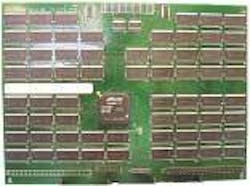
SAN DIEGO — U.S. Air Force officials recently selected the Proton100k computer from Space Micro in San Diego as the flight payload computer for the Roadrunner Onboard Processing Experiment (ROPE), on the U.S. Air Force Roadrunner satellite program.
The program is a 250-kilogram satellite being developed by the Air Force Research Laboratory's Space Vehicles Directorate under the Responsive Space Program (RSP). In addition to the Proton100k satellite computer, Space Micro engineers will deliver a 64-gigabit solid-state data recorder. The Proton100k flight computer will be used by ROPE as its instrument computer, performing data management and processing of focal-plane-array data.
The Proton100k "offers the combination of high speed, low power, and radiation tolerance in one computer", says David Czajkowski, chief operating officer for Space Micro.
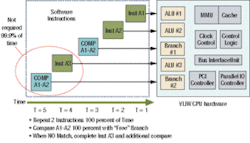
The computer uses Space Micro's advanced single-event upset (SEU) and single-event functional- interrupt (SEFI) mitigation technologies. SEU is mitigated with the Time-Triple Modular Redundancy, or TTMR, built into the computer hardware and software, while SEFI is mitigated using Space Micro's Hardened Core circuits. Combining these technologies into a single product enables the use of advance, commercial microprocessors in the harsh environment encountered in space, Space Micro officials say.
"TTMR has the potential to greatly aid in the design of a space radiation–hardened single-board computer," Czajkowski says. "The first step is continued testing and validation of TTMR to ensure that SEUs are mitigated in a radiation environment. SEFI must be addressed independently and an improved SEU mitigation technique must be developed for outbound data that is sent through any microprocessor bus peripheral. In order to make use of TTMR, a VLIW (very low instruction word) microprocessor must be qualified for total-dose and single-event latchup radiation tolerance.
"Fortunately, there are at least three manufacturers building VLIW processors on Taiwan Semiconductor, which recently has been shown to have excellent total-dose and single-event latchup characteristic," Czajkowski continues. "The advantage in using one of these three VLIW processors (Transmeta's Crusoe, Trimedia's TM-32A, or Equator's BSP-15) is unprotected performance in the range of 1,750 MIPS and SEU protected performance in the range of 1,130 MIPS. Since VLIW processors were originally designed for low power consumption, typical power at full speed is approximately 5 watts and 1 watt at 250 MIPS.
"Using TTMR in a typical development environment will require integration of TTMR algorithms into a microprocessor's standard software development tools," Czajkowski says. "The most likely location for the algorithms is a precompiler that takes the application code and translates the original code into TTMR code. An obvious benefit of this implementation is that the application can decide which code to run in TTMR mode, turning TTMR on and off as desired."
The Space Micro computer has a total dose tolerance of 100 kilorads and a SEU error rate of less than 1E-5 unrecoverable errors/day. It comes in a Compact PCI 3U form factor with a 64-bit microprocessor with 2,400 MIPS performance at 400 MHz, 32 Kbit instruction cache, 16-Kbit data cache, 64-Mbytes SDRAM with error detection and correction, and 7 to 9 watts of power, depending upon peripheral selection, Space Micro officials say. The computer is compatible with the VxWorks real-time operating system from Wind River in Alameda, Calif., and Linux.
Space Micro was founded in 2001 as a satellite-technology research and development company. Its management team includes two of the founders of Space Electronics — Czajkowski and Dave Strobel. Space Micro has been completing research in design solutions for single-event-effects damage, plus methods for improving single-event-effects performance of microelectronics, for several companies and government agencies. Key government customers include NASA, the Missile Defense Agency (MDA), and the Air Force.
For more information on Space Micro contact the company at 858-487-9295 or online at www.spacemicro.com.
