Crane developing microsensor network for homeland security and defense
By John McHale
PLANO, Texas - Officials at Crane Aerospace & Electronics Advanced Integrated Systems Division (AISD) are currently in the third phase of a four-phase program with the U.S. Army to develop technology for a microsensor network for defense and homeland security applications.
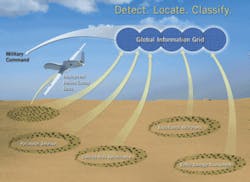
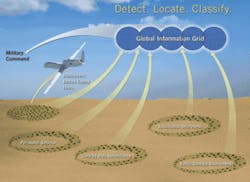
Crane engineers have developed a microsensor system (MSS) using disposable sensors, which automatically form a wireless network capable of sending critical situation information to a command center.
“The MSS project and the proposed enhancements to this project are by far one of the most promising technologies under development that we have witnessed,” says Jason Denno, Army deputy director for Battle Command Battle Lab at Fort Hood, Texas. “Completion of the MSS project has the potential to greatly impact immediate critical Army Intelligence shortfalls.”
Coupling sophisticated energy-aware communications architectures, with low-power and low-cost sensors, Crane is developing several next-generation wirelessly networked unattended ground-sensor systems such as the MSS and the Chameleon Sensor Network, for defense and homeland security applications.
Crane’s system lays down a greater number of sensors than any other system and does so at a lower cost, says Charlie Stuewe, vice president and general manger of Crane AISD. It enables security planners to implement a wireless security network without complex planning.
Other systems are developed to focus on one person or one area and are very expensive and not developed in mass numbers, Stuewe says.
Utilizing a layered network approach, the MSS system collects critical information from groups of massively deployed sensors. Capable of meeting numerous detection and surveillance missions, MSS will provide a cost-effective method of detecting a dismounted threat. Mission-specific fusion from multiple sensors such as magnetic, acoustic, IR motion, biological and chemical, enable MSS to provide early warning, asset protection, targeting, and other support roles to protect our battlefields, borders, and national assets.
MSS applies multiple transceivers- acoustic, seismic, IR, etc., and fuses the different sensor systems to get a reduced false-alarm rate, Stuewe says. MSS runs on lower power and a lower data rate for surveillance-2.4 GHz, he says.
MSS is very effective for those that who do not need a one-to-one solution but want lower cost per area, says Kevin Benson, program manager for MSS at Crane.
The size of the sensor deployment depends on the mission requirements, Stuewe says. MSS is very scalable, he adds. It can even be dropped out of an unmanned aerial vehicle and deployed instantly, Stuewe says.
Stuewe says his team has also been in talks with the Department of Homeland security where high-volume security scenarios need the flexibility and network capability of MSS.
One of the unique aspects of the MSS program is the combination of networked wireless sensing devices with electronics miniaturization technology. Two partners with Crane Aerospace & Electronics/AISD-North Dakota State University (NDSU) and the University of Alaska Fairbanks (UAF)-are building centers of excellence for electronics miniaturization technology in support of the Department of Defense. NDSU is building a prototype facility for chip-scale packaging and fluidic self-assembly technologies. UAF is building a fabrication line for chip-scale packaging. These technologies will enable the MSS radio to shrink to a very small size on the order of 1 cubic inch.
MSS is packaged for covert operation, has energy aware communications protocols, collaborative sensor data processing, and a non line of sight capability enables usage and deployment scenarios.
The Chameleon Sensor network is designed for a covert mission in which both the sensor and its communications with the base station must not be detected. Ultra-low-noise receiver technology is to be fully integrated in a base station packaged in a portable briefcase size. Features such as high- data-rate non-line-of-sight communications are focused on obtaining the greatest amount of information from a targeted threat, while minimizing the risk to the security of the operation, Crane officials say.
For more information, go online at www.craneaerospace.com.
