Industry View: Have bandwidth, will travel
Portability with low size, weight, and power comes to long-range laser communications for tactical and strategic ground-to-ground and ground-to-air mobile applications
By Jim Reeves
Laser communications technology is still in its infancy for military and aerospace applications that call for extended range, security, and portability. Commercial laser communication systems today lack the attributes most necessary to assist ground and air forces in a battlefield environment.
These bulky, limited-range systems have only found limited success in applications such as building-to-building optical networking extensions, which may explain the government’s lack of enthusiasm for such systems over the years. All of that is about to change, however, with the advent of adaptive communications and other technologies.
Technological advancements are making it possible to introduce newly developed products that enable laser communication systems that are man-portable, far reaching, low power, and perfectly suited for the military’s security-driven battlefield communication requirements.
This latest evolution in laser communications represents a distinctive paradigm shift for providing the necessary transmit and receive bandwidth to enable full use of the three-dimensional sensor data from various surveillance platforms. One such technology breakthrough, known as double conjugated adaptive optics, is paving the way for enabling the future of long-range, portable laser communications-and military ears are finally perking up.
Current market climate
Today’s laser communications market consists mainly of free-space optics-systems that can communicate data point-to-point with very large bandwidth capacities. These commercial systems gained popularity as short-range optical links between two buildings where deploying fiber was either impossible or too expensive. Although these applications were successful, laser communications systems integrators still have problems extending laser reach.
Atmospheric turbulence, platform jitter, beam control, beam focus, and internal local aberrations are just a few of the potential problems of passing a signal through the air. Atmospheric conditions such as fog, smoke, and smog, can easily attenuate or distort the signal. The immediate solution often requires larger systems to transmit signals strong enough to burn through these conditions, yet even the best free-space optics system is limited to a few kilometers.
Since the short range of today’s commercial laser communications systems requires substantial power and platform size, ground-transportable, ground-to-air, or air-to-ground mobile links for pushing sensor and image data around the battlefield traditionally do not exist. Although the military and aerospace community is interested in finding applications for laser communications, the current commercial systems have fallen far short in too many areas and are poor representations of the technology’s true capabilities. However, one relatively new technology-adaptive optics-is generating substantial new interest in the use of laser communications in military applications for airborne and ground-based systems.
In a battlefield environment, for instance, all types of surveillance and geographical intelligence data are continually gathered. However, secure transmission to other ground and airborne platforms that can take advantage of the data is inherently difficult. How can the data go from a ground sensor to a low-flying aircraft? How does information get from a low flyer to a surveillance aircraft? How does it get from the surveillance aircraft to the satellite? Finally, how can data go point-to-point across ground locations more than 15 miles apart? The answer is a patented new application of adaptive optics technology that is poised to transform laser communications for military applications.
Adaptive optics
Adaptive optics in a laser communication system consists of a multivariable servo loop that derives an error signal from a wave-front sensor and controls a deformable mirror to correct the wave front. The sensor requires a light source to illuminate the optical path whose index disturbance is to be corrected. To address military battlefield problems, double conjugated adaptive optics has been developed.
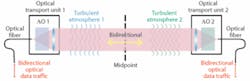
Double-conjugated adaptive optics enable two systems to talk to each other by establishing a wave-front sensor validation of the incoming signal and adjusting the outgoing signal. In other words, the signal is conditioned in a bidirectional, duplexed link by a very sensitive wave-front sensor. The incoming signal is checked to identify and measure the aberrations and atmospheric turbulence that is affecting it, and then the outgoing signal is conditioned to match those environmental variations (see Figure 1).
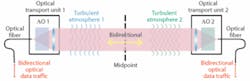
This real-time adaptation of the beam link to the environment allows for beam focus within four centimeters. This, in turn, enables a reduction in power demand and provides for fine steering of the beam to maintain the link. By continually tracking the signal, and adjusting for atmospheric conditions, transmissions can not only be longer range, but can better pass through rain, smoke, fog, and dust.
Size matters
There are several unique characteristics associated with this adaptive-optics technology and each contributes to achieving a small, low-power, long-range, man-portable, laser communication system anywhere on the battlefield. The user can extract data from the environment, and link that data to a platform as far away as 12 miles-with total covertness and virtually no probability of intercept or detection-in a matter of seconds.
By using a bidirectional adaptive optics method of beam control, users can set up and test a laser communications system that achieves ranges of more than 18 miles in live demonstrations. Because of the nature of the eye safe 1550-nanometer signal, the probability of intercept or detection is extremely low. In fact, it would require a similar sensor to be inserted directly within the 4-centimeter invisible optical path or link.
One such system, currently available, specifies a 12-mile range in normal conditions-a 10× improvement over other available products-also boasts significantly small size, weight, and low power. The unit is battery powered for more than eight hours of operation and weighs 26 pounds.
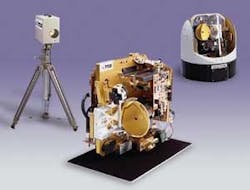
The entire mobile system is built into a 9-by-11-inch tripod-mountable chassis (see Figure 2). The military applications involve moving broadband data across challenging environments that are cooperative and noncooperative.
The future of battlefield communications
Until now, laser communications and adaptive optics, with the exception of commercial free-space optics systems, has been limited to laboratory experimentation. Major system-integrator companies have experimented with different types of electro-optical systems for communications and weapons.
The same technology that was used in astronomy telescopes is being shrunkdown and retrofitted for a new line of military and aerospace communication systems. In addition, adaptive optics can be applied to other electro-optical-based sensors and imagers for beam control and range extension. Typical applications would be laser target designation and LIDAR (light detection and ranging). This technology can also be adapted to extend range and reduce power demand on directed energy platforms since adaptive optics module assemblies achieve extremely effective beam conditioning characteristics.
Jim Reeves is vice president of marketing and business development for AOptix Technologies (www.aoptix.com) in Campbell, Calif. He can be reached by e-mail at [email protected].
