White Sands Missile Range moves to digital high-speed cameras
By John Keller
WHITE SANDS MISSILE RANGE, N.M. - The desert of south-central New Mexico has a rich history in research and development of nuclear weapons and advanced missiles. As such, this area now know as the U.S. Army’s White Sands Missile Range also is one of the most important users of high-speed photography in the world.
This area, once known as Trinity, perhaps is best known as the site 60 years ago of the explosion of the first atomic bomb. This Trinity experiment on July 16, 1945, in which a plutonium bomb was assembled and detonated to produce an intense flash and a fireball, effectively ushered in the nuclear age.
Researchers six decades ago might not have been able to glean as much information from the Trinity experiment as they did without the use of high-speed photography. Vivid high-speed photos of the Trinity nuclear detonation are available on the World Wide Web at www.wsmr.army.mil/pao/TrinitySite/tpixind.htm.
High-speed photos taken with 16- and 35-millimeter cameras, as well as with larger-format cameras, captured the world’s first nuclear explosion over the course of 15 seconds to document just exactly how a nuclear blast behaves. Images were taken at 0.006, 0.016, 0.025, 0.053, 2, 4, and 15 seconds.
Today high-speed photography is just as important at White Sands Missile Range as it has ever been, to help scientists understand the flight dynamics and behavior of some of the world’s most advanced missiles.
White Sands Missile Range offers testing capabilities and infrastructure, from management of the largest open-air/over-land missile range in the northern hemisphere. Some of the range’s experiments center on Joint Cruise Missile Defense, the Missile Defense Agency, Future Combat Systems (FCS), directed energy, interoperability, modeling and simulation, unmanned aerial vehicles (UAVs), and robotics.
Until now, photographers at White Sands who are in charge of capturing the most minute details of supersonic missile flight have relied on high-speed 16- and 35-millimeter film cameras. Range officials, however, decided they could gather more information by using new generations of high-speed digital cameras.
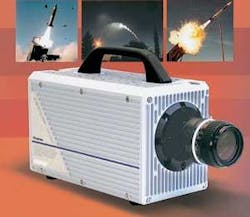
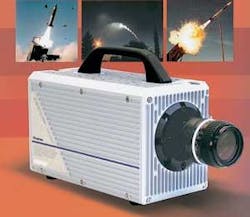
Toward that goal, range officials awarded a contract for more than $2 million to Photron USA Inc. in San Diego for 26 ultima APX-RS high-speed digital camera systems to replace aging 16- and 35-millimeter high-speed film cameras now in use. Ultimately, White Sands officials seek to replace as many as 75 high-speed film cameras.
For the demanding photography work at White Sands, scientists needed cameras able to take images of 1,000-by-1,000-pixel resolution at speeds of 1,000 frames per second, with a minimum record time of at least eight seconds, as well as Gigabit Ethernet compatibility. They narrowed the list of potential suppliers to three before finally choosing Photron, company officials say.
The Photron ultima APX-RS camera has 17 colors, Gigabit Ethernet, and 16 gigabytes of memory for 12 seconds of record time at 1,000 frames per second. For more information contact Photron USA online at www.photron.com.