Titan and Carlo Gavazzi provide rack-mount systems for NAVSSI program office
By John McHale
SAN DIEGO - U.S. Navy officials are using components from Titan Advanced Products & Design Division (AP&D) in San Diego and Carlo Gavazzi Computing Solutions in Brockton, Mass., for an integrated shipboard navigation system.
Experts from the Navy Navigation Systems Program Office are using rack-mount systems from Titan and a VME chassis from Carlo Gavazzi for the Navigation Sensor System Interface (NAVSSI) system.
The AN/SSN-6 NAVSSI system automatically accepts, processes, and disseminates navigation and time information from different shipboard navigation sources, and helps navigators verify data, use digital maps, and program waypoints. The Navy Navigation Systems Program Office is part of Space and Naval Warfare Systems Command (SPAWAR) in San Diego.
“NAVSSI is designed to collect, process, integrate, and format precise navigation and time (PNT) data for distribution,” explains Cmdr. Frank Arata, navigation integration product team at the Navy Communications Program Office.
NAVSSI interfaces with all shipboard navigation sensor systems, including inertial navigation systems such as the ring-laser-gyro navigator, global-positioning system (GPS), gyrocompasses, speed logs, wind sensors, fathometers, and digital magnetic compasses such as the Flux Gate Magnetic Compass.
“NAVSSI accepts the outputs of these systems and uses them to build, in real time, a ‘superset’ of PNT data that contains all of the information required by Aegis, SSDS, various weapons systems including MK 86 GFCS, Mk 34 GWS, RAM, and several others,” Arata says.
“Titan is providing hardware system integration, design, and support services for NAVSSI systems,” says Larry Vernec, senior vice president of marketing and business development at Titan AP&D.
Titan engineers deliver rack-mount systems that network with other ships, submarines, and test sites for training and to simulate battle situations anywhere in the world, Vernec says. Titan has been involved with the NAVSSI program for more than six years, delivering about 120 rack-mount systems, he adds.
“NAVSSI is required to be fully environmentally qualified, including Grade ‘A’ shock,” Arata says. “Each new component must be built to those standards, and either retested if one of our racks is being retested, or qualified by extension. So we look for vendors that have already fully qualified their component that will utilize the same or less space in our racks without adding to the overall parametric envelope-size, power, heat dissipation, etc.”
Carlo Gavazzi provides the 709 Series VME chassis in Titan’s NAVSSI systems. The 20-inch-deep 709 Series has bolted or welded construction, as many as 20 slots, and power supplies that handle loads as strong as 1,000 watts. The chassis has optional disk drives, a vertical load enclosure, and ranges from 8U to 15U high, says Ted Brewster, vice president at Carlo Gavazzi.
“Carlo Gavazzi collaborated with Titan AP&D to enhance and hone the chassis designs, helping produce chassis that meet our customer’s specific requirements, and pass full mil-spec testing [shock, environment, vibration, etc.],” Vernec says. Titan AP&D recommended Carlo Gavazzi to NAVSSI as a key vendor for the program, he adds.
NAVSSI has two basic parts: the computer based on Motorola PowerPC processors and Wind River Systems VxWorks real-time operating system, and a display with Sun-based processor and Solaris operating system, Arata notes. “Virtually all of NAVSSI is COTS; there are no uniquely government-developed NAVSSI hardware components.”
Changing system interfaces
“One of the consistent challenges faced by the NAVSSI program is the need to accommodate constantly changing system interfaces,” Vernec says. Signal interface changes for new applications that require specific positioning data require new cabling, metal work, rack space, and testing.
“Primarily we have attempted to establish, and enforce, a ‘network-enabled’ superset message that contains all of the data available so that a user system can pick and choose those elements they need,” Arata says. “In a perfect world, each new user system could get all of the PNT data they needed from our ‘superset’ message. However, the reality is that this is not always possible. Some systems require data at different frequencies or at a different latency and are unable to accept the ‘standard’ message.”
In such cases, NAVSSI can build system-specific output messages and add them into the next software release, which can then be fielded either as a new block of NAVSSI, or as an engineering change order.
To address this situation, Titan engineers came up with a baseline system that meets immediate requirements, yet accommodates constant change, Vernec says. Titan delivers upgrade kits to ease technology insertion and maintain commonality from version to version. Engineers can insert new technologies into existing systems without replacing the whole rack or building a new system.
“Our focus is to design and create systems with ease of use in mind, helping make them operator-friendly, more accessible, and less labor intensive when accommodating new technologies, upgrades and replacements,” Vernec says. “The result is less down time, reduced costs, and easier user access for equipment operation and maintenance.”
NAVSSI is an evolutionary spiral-development program fielded in successive blocks, Arata explains. “Obsolescence of hardware issues are primarily addressed when a new block is fielded; a replacement for the hardware is introduced at that point.”
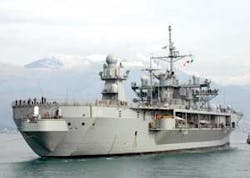
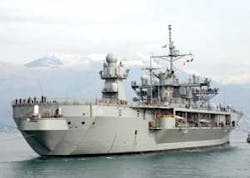
Naval vessels NAVSSI include aircraft carriers, cruisers, destroyers, San Antonio-class amphibious transport docks, the amphibious command ships USS Blue Ridge and USS Mount Whitney, and two dock landing ships, Arata says.
NAVSSI also is installed in the amphibious assault ship USS Makin Island (LHD 8), which is under construction, and will be backfit into the first seven Wasp-class amphibious assault ships beginning next year. NAVSSI is configurable for each class, and for different combat systems suites of different ships within the same class.
For more information on Titan AP&D go online at www.titan.com. For more information on Carlo Gavazzi Computing solutions visit www.gavazzi-computing.com.
