Northrop Grumman shoots 27-kw beam of light for 350 seconds from solid-state laser
By John Keller
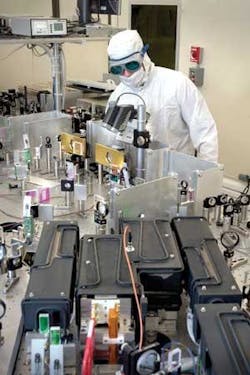
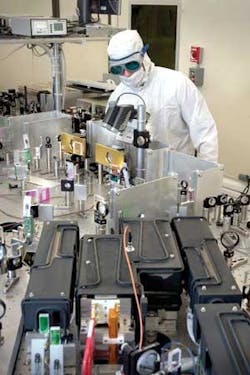
REDONDO BEACH, Calif. - A high-energy, solid-state laser from Northrop Grumman Corp. for the U.S. military has fired one of the most powerful beams yet produced by an electrically powered laser of more than 27 kilowatts with a run time of 350 seconds, company officials say.
In posting those achievements, the company says it surpassed the power and run-time requirements of the Joint High Power Solid-State Laser (JHPSSL) Phase 2 demonstration program, a military effort to leapfrog speed-of-light technology.
In a separate test, the laser demonstrated beam quality at 19 kilowatts, sufficient to focus on a target, company officials say.
The U.S. Air Force Research Laboratory at Kirtland Air Force Base, N.M., and the Office of the Secretary of Defense-Joint Technology Office, Albuquerque, funded the JHPSSL program.
“The solid-state technology we’ve demonstrated will serve as the architectural foundation for a whole class of lasers that could be applied throughout much of the U.S. military,” says Alexis Livanos, president of Northrop Grumman’s Space Technology sector.
Potential uses include protective and strike capabilities for ships, manned and unmanned aircraft, and ground vehicles.
“To our knowledge, these achievements make the Northrop Grumman laser the brightest, continuously operating, solid-state laser demonstrated to date,” Livanos says.
“Solid-state lasers will add new force protection and joint warfighting capabilities across military services,” says Art Stephenson, vice president of Directed Energy Systems at Northrop Grumman Space Technology.
“During the past five years, through the Tactical High Energy Laser program executed in conjunction with the U.S. Army, we’ve shown the effectiveness of a high-power laser system against a variety of in-flight rockets, artillery, and mortars,” he says.
“We have also shown that the lethality of a laser results from much more than just the power level. The laser must have good beam quality and a long run time, which are proven hallmarks of our systems. Our solid-state laser approach has been shown to be ‘scalable’ to high power levels without stressing the components. That’s why we believe it’s time to take high-energy lasers out of the lab and begin integrating them onto the battlefield.”
The U.S. military is using Northrop Grumman’s low-power, solid-state lasers for target designation and range finding. In addition, a Northrop Grumman solid-state illuminator laser, the Beacon Illuminator Laser-the most powerful solid-state laser on the Airborne Laser (ABL)-is ground testing now.
The company is also under contract to build a more capable follow-on illuminator, the Strategic Illuminator Laser, which is only a few years away, he added. Northrop Grumman built the megawatt-class laser for ABL, the Chemical Oxygen Iodine Laser.
For more information contact Northrop Grumman online at www.northropgrumman.com.
