Sponsor


Global Hawk uses Raytheon optics
January 1, 2006

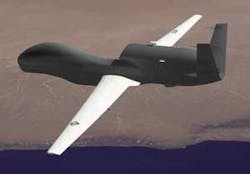
Pilots of the Global Hawk unmanned aerial vehicle (UAV) monitor enemy targets with an electro-optical/infrared (EO/IR) high-resolution imaging system built by Raytheon, Corp.’s Space and Airborne Systems division, El Segundo, Calif.

Combined with other sensors, the package is called the Integrated Sensor Suite (ISS), and is slated to fly aboard the Northrop Grumman RQ-4A ­Global Hawk. Raytheon delivered the first production shipment of Lot-3 units in November.

ISS combines a cloud-penetrating synthetic aperture radar (SAR) antenna with a ground moving target indicator (GMTI), a high-resolution electro-optical (EO) digital camera, and an infrared (IR) sensor. Because those components are integrated, battlefield commanders can select radar, infrared, or visible wavelength modes to suit their mission.
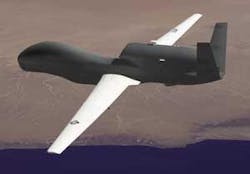

The Global Hawk will use a high-resolution imaging system from Raytheon to monitor enemy targets.
Click here to enlarge image

Current ISS units provide near-real-time imagery for missions in Iraq. Raytheon engineers are also building a next-generation enhanced ISS, which will extend the range capabilities of both the SAR and EO sensors by 50 percent over the basic ISS. For more information, see www.raytheon.com.

Global Hawk is a high-altitude, long-endurance craft that can linger at 60,000 feet for 36 hours, providing intelligence, surveillance and reconnaissance (ISR) data to military field commanders. Used to scan large areas, they can cover an area of 40,000 square nautical miles with 1-meter resolution within 24 hours, or to spot specific targets, they can search 1,900 2-by-2-km spots with 0.33-meter resolution.

Social Media Tools

Sponsored by:
Recommend this Article Recommend this Article () You Recommended this Article You Recommended this Article ()

REPRINTS: Is your company featured in this article? Click here to purchase reprints.


Most Popular Articles

Webcasts

On Demand

DO-178C: The Evolution of Software Technology in Safety

This webinar will examine the impact these supplements will have on certifiable aircraft software development, the developers and the processes which are used.

Sponsored by:

Small Form Factor

Join Military & Aerospace Electronics for an insightful Webcast on small form factor systems and components, including the benefits that SFF innovations hold for current and future mil-aero applications....

VPX for Unmanned Systems

Join us for this webcast as we hear from VITA and industry experts on the latest developments in VPX technology.

Mil & Aero Magazine

February 2012
Volume 23, Issue 2

M&AE Article Archives

Close this offer Close
Military & Aerospace Electronics Defense Executive Ebedded Computing Report Avionics Intelligence
Subscribe
FREE Newsletters from the Aerospace & Defense Media Group
Required field
Required field
Required field
I would like to receive the following e-mail newsletters
Military & Aerospace Electronics Weekly Yes No Required field
Defense Executive Yes No Required field
Embedded Computing Report Yes No Required field
Avionics Intelligence Yes No Required field
In order to subscribe, you must select at least one newsletter above.
No Thanks. No Thanks