BAE Systems gains F-35 JSF production contract to deliver EWCS
By Courtney E. Howard
NASHUA, N.H. - The U.S. Department of Defense (DOD) and F-35 Joint Strike Fighter (JSF) program partner Lockheed Martin of Bethesda, Md., have awarded BAE Systems of Nashua, N.H., a contract to begin low-rate production of the JSF.
BAE Systems will begin procurement of materials, including titanium, for the production of five conventional take-off and landing (CTOL) aircraft. The state-of-the-art F-35 aircraft will take advantage of BAE Systems’ communications, flight control, and electrical technologies.
BAE Systems’s engineers are responsible for the design, manufacture, and assembly of the F-35 JSF aft fuselage and empennage (vertical and horizontal tails), in addition to lending expertise to the aircraft’s crew escape system, fuel system, life support system, and prognostics health management system integration.
The F-35 single-engine stealth fighter is to replace various existing aircraft, including AV-8B Harriers, A-10s, F-16s, F/A-18 Hornets and United Kingdom Harrier GR7s and Sea Harriers.
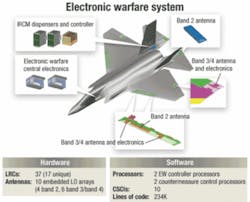
BAE Systems’s F-35 JSF electronic warfare countermeasures system (EWCS) boasts digital receiver architecture, according to Dan Gobel, Joint Strike Fighter (JSF) director for BAE Systems.
The system employs less hardware and more software than other EWCS solutions, translating to greater effectiveness, upgradeability, and flexibility and reduced size, weight, and power requirements. Moreover, it is designed to provide the pilot with 360 degrees of situational awareness.
The JSF program is currently in the System Design and Development phase, which will see the production of 23 test aircraft. Fifteen F-35s will undergo flight test, seven will be used for static testing and another will validate the aircraft’s radar signature. The first flight of the first F-35 JSF, a preproduction conventional takeoff and landing variant, is planned for autumn 2006.
This event marks the first of seven Low Rate Initial Production batches for the F-35 JSF. BAE Systems representatives anticipate securing the full contract for the first production aircraft in the first quarter of 2007.