Boeing manned/unmanned light helicopter uses latest digital technology
By John McHale
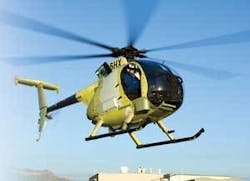
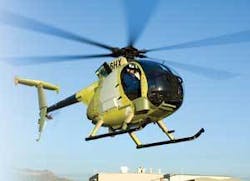
ST. LOUIS - Boeing Integrated Defense Systems in St. Louis recently flew its newly designed A/MH-6X light-turbine helicopter for the first time. The aircraft sports the latest in digital technology with a new glass cockpit.
The aircraft combines the performance of the A/MH-6M Mission Enhanced Little Bird (MELB) with the unmanned aerial vehicle technologies of the Unmanned Little Bird (ULB) Demonstrator, a modified MD 530F civil helicopter that has been in development since 2004.
“The A/MH-6X is the first true hybrid manned/unmanned aircraft, adding another mission capability to the combat-proven, multimission MELB helicopter,” says Dino Cerchie, Boeing Advanced Rotorcraft Systems Unmanned Little Bird program manager. “The A/MH-6X Little Bird offers exciting new possibilities for an already outstanding platform.”
Boeing designed and developed the derivative helicopter for military and civilian applications, including Homeland Defense. The helicopter’s external appearance and mechanical systems are similar to the operational A/MH-6M helicopter flown by the U.S. Army’s 160th Special Operations Aviation Regiment at Fort Campbell, Ky.
Boeing made the most significant modifications to the cockpit avionics and electrical systems. The A/MH-6X aircraft has a prototype “glass” cockpit that provides system redundancy and additional technologies in digital maps and data fusion. It also has many network-centric features like Ku-band communication, digital radios, Internet Protocol-addressable aircraft systems and on-board, high bandwidth data processing and storage.
“The unmanned hardware and capability developed in this program can be installed in any helicopter,” Cerchie says. “The A/MH-6X Little Bird aircraft provides exceptional performance, capability and reliability for manned or unmanned missions in a compact, highly transportable aircraft that can leverage many existing qualified aircraft systems.
The A/MH-6X lifted off Sept. 20 at the Boeing Rotorcraft Systems facility in Mesa, Ariz., and flew as a piloted aircraft for approximately 14 minutes before landing safely.
Following the flight, Boeing test pilot Todd Brown reported, “The aircraft flew great. It is very responsive and delivers outstanding performance.”
Future testing will expand the manned and unmanned envelopes. Aircraft performance will be similar to the ULB Demonstrator with an additional 1,000 pounds of payload that can be used for increased range, endurance, or mission hardware. Total payload for the ULB Demonstrator is greater than 2,400 pounds.
“The demonstrator, which first flew just over two years ago, has logged nearly 500 manned and unmanned flight hours,” he adds. “The first flight of this much more capable A/MH-6X was a logical extension of an outstanding developmental program. The team has made it look easy, but it has taken a lot of hard work by some very dedicated folks.”
Boeing is preparing the manned/unmanned aircraft variant for domestic and international markets.
“The desire and need for an all-purpose compact workhorse is there, whether it’s manned or unmanned,” Cerchie adds. “This aircraft is the low-cost solution for urban or confined operational areas where full mission capability and connectivity are required.”
