RF MEMS market will reach $1.1 billion by 2009
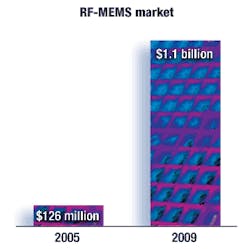
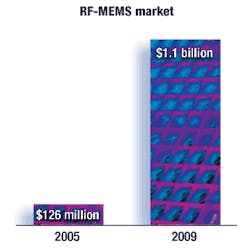
The market for radio-frequency microelectrical mechanical systems (RF MEMS) components will grow from $126 million in 2004 to more than $1.1 billion in 2009, according to a study by Wicht Technologie Consulting (WTC) in Munich, Germany.
Driving this demand will be military applications, automated test equipment (ATE), mobile telephony, and consumer information technology, according to WTC analysts.
The study covers applications, requirements, and markets for RF MEMS switches, tunable capacitors, BAW devices including film bulk acoustic resonators (FBAR) and solidly mounted resonators (SMR), in addition to micro-mechanical resonators, MEMS inductors, and cavity resonators.
More than 60 companies are currently involved in RF MEMS manufacturing, with one-quarter of those shipping commercial products or samples in 2005.
The major part of the market in 2004 was for bulk acoustic wave (BAW) devices, which include duplexers and filters for mobile phones. This product will continue to dominate and constitute around 40 percent of the total market in 2009.
Another growing market sector will be MEMS switches and micromechanical resonators. As designers solve problems with reliability, packaging, and CMOS integration, demand will grow in volume and high-end markets.
In general, development efforts will focus on architecture instead of components, as designers try to develop novel arrangements that leverage the potential of RF MEMS.
The bulk of the RF MEMS market today serves mobile telephony applications, with BAW duplexers and filters supplied largely by Agilent and Infineon. In 2006 and 2007, a second mass market will emerge for consumer and IT applications with micro-mechanical resonators.
“There are great opportunities for spinoff applications in consumer and IT sectors following the initial focus on telecom applications,” says Jeremie Bouchaud, the report’s author. “Here, micro-mechanical resonators will be used not as filters, but rather as timing devices.”
Outside of mass markets, the best opportunities are in automated test equipment (ATE), followed by military applications. For more information contact WTC online at www.wtc-consult.de.
