New Global Hawk production aircraft surpass 1,000 combat hours
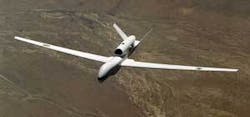
Two new Air Force RQ-4 Global Hawk unmanned aerial reconnaissance systems, built by Northrop Grumman Corp., have flown approximately 50 missions and more than 1,000 combat hours in support of coalition forces since their deployment in the Persian Gulf in January of this year. The initial production versions of the Global Hawk have improved sensor capabilities over previous Global Hawk versions.
“Our No. 1 goal is to support the persistent intelligence collection needs of the warfighter,” says George Guerra, Northrop Grumman program director for Global Hawk. “The system is quickly proving to be an even more valuable reconnaissance asset than the originally deployed assets.”
“We are extremely pleased with the system’s performance to date and the unique capability that it provides to the warfighter,” says Col. Willie Nunn, chief of the Air Force’s Air Combat Command/A8H high-altitude ISR division. “As the system continues to mature, we will be able to provide even more ISR capability to our armed forces.”
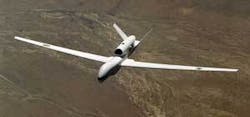
The Global Hawk system was first deployed as advanced concept technology demonstration vehicles shortly following the attacks of Sept. 11, 2001. Global Hawks have now flown more than 6,000 hours and 260 missions in support of the global war on terror, and the family of Global Hawk aircraft has accumulated more than 10,000 flight hours over all missions.
The Global Hawk system, featuring an unmanned air vehicle that flies at altitudes of more than 60,000 feet, can survey vast geographic regions with pinpoint accuracy. Once mission parameters are programmed into Global Hawk, the vehicle can take off, fly, return, and land autonomously. It can be retasked at a moment’s notice to meet the immediate intelligence needs of battlefield commanders.
The Northrop Grumman-led Global Hawk industry team comprises U.S. and international companies. The unmanned system’s primary program elements are provided by the following team members:
- Integrated sensor suite: Raytheon Space and Airborne Systems, El Segundo, Calif.
- Ground station: Raytheon Intelligence and Information Systems, Falls Church, Va.
- Engine: Rolls-Royce Corporation, Indianapolis, Ind.
- Communication system: L-3 Communications, West, Salt Lake City, Utah.;
- Wing: Vought Aircraft Industries, Dallas, Tex.
- V-tail assembly and other composite structures: Aurora Flight Sciences of West Virginia, Bridgeport, West Va.
