By Courtney E. Howard
SAN DIEGO–Engineers at Science Applications International Corp. (SAIC) in San Diego are designing and developing a sensor inspired by the canine’s sense of smell.
The quick and accurate detection and identification of chemicals and chemical combinations, such as explosives and chemical and biological weapons, is critical in military and aerospace environments.
Current detection methods, including advanced chemo-sensors, still fall short of a canine’s innate ability to detect thousands of chemicals. DARPA officials are determined to replicate this efficient biologic system with the help of SAIC engineers.
SAIC won from the Defense Advanced Research Projects Agency (DARPA) Defense Sciences Office in McLean, Va., a contract having a 15-month base period of performance, one six-month option, a single one-year option, and a total value of $18 million if all options are exercised.
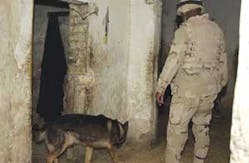
DARPA’s RealNose program, for which the sensor is being developed, is intended to build an artificial “nose” and next-generation detection system with capabilities that supersede those of a canine’s olfactory system.
Under the contract, SAIC will model, design, and develop a sensor that includes subsystems for air/odor intake, detection using olfactory receptors, signal transduction, and pattern recognition to identify odors.
“The integration of these components into the resulting RealNose device will produce a revolutionary olfactory capability for chemical identification,” explains a DARPA representative. “By simulating the entire mammalian olfactory system, from air intake to pattern recognition, revolutionary detection capabilities will be created, demonstrating canine-comparable specificity, distance, and detection thresholds.”
The resulting sensor will be integrated into a detection system intended to help protect U.S. forces in war zones through the timely and accurate detection of explosives and weapons.
“There is a critical need for sensitive detection and accurate identification of chemicals and mixtures of chemicals, such as explosives and chemical weapons that threaten our deployed troops,” says John Fratamico, SAIC senior vice president and business unit general manager. “This is a challenging project at the interface between biology and chemistry.”
Work on the contract will take place primarily in San Diego and is expected to be completed by December 2010.
For additional information about the RealNose program, visit SAIC and DARPA online at www.saic.com and www.darpa.mil, respectively.