Raytheon delivers prototype missile warning sensor

By Courtney E. Howard
WALTHAM, Mass.—Raytheon Co. in Waltham, Mass. has built and tested an integrated infrared sensor for the Risk Reduction Alternative Infrared Satellite Systems (RR-AISS) program.
This Raytheon-built sensor is expected to outperform current Defense Satellite and Space-based Infrared System programs, both of which employ complex scanning mechanisms to perform full-earth surveillance of missiles and other infrared targets.
The RR-AIRSS program, sponsored by the U.S. Air Force Space and Missiles Systems Center and managed by the U.S. Air Force Research Laboratory Space Vehicles Directorate in Albuquerque, N.M., is designed “to prove that wide-field-of-view infrared sensors can maintain persistent full-earth surveillance for missile warning in a relatively small, low-risk, and easily manufactured payload,” according to a representative.
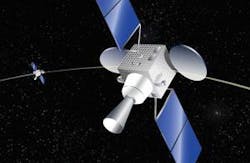
“The RR-AIRSS sensor is an important part of the evolution of our nation’s missile warning capabilities,” says Brian Arnold, vice president for Raytheon’s Space Systems organization. “When potential missile threats can come t oday from anywhere on earth, a persistent, whole-earth-staring capability provides the enhanced detection sensitivity and responsiveness our warfighters need to make critical decisions.”
Raytheon engineers and partners achieved this sensor milestone ahead of schedule, in less than 18 months. “This achievement is the result of innovative thinking, tightly managed program execution, and close coordination between Raytheon and our partners at the laboratory and the Space and Missile Systems Center,” Arnold says.
Raytheon personnel have used the sensor system to collect test pattern images that demonstrate both telescope image quality and focal plane functionality. Preparations are underway to complete environmental testing, after which the sensor will be delivered to the Air Force Research Laboratory for further evaluation.
For more, visit www.raytheon.com.
