Shortwave infrared gives imaging capability to small tactical unmanned aerial vehicles
By David G. Dawes and Martin H. Ettenberg
From top leaders in the Pentagon to commanders in theater, decision makers at all levels across the U.S. Department of Defense (DoD) exploit intelligence, surveillance, and reconnaissance (ISR) data. For years, the famous U-2 spy plane has been the workhorse of the intelligence community collecting vital reconnaissance data for military planners. Yet today’s global war on terror (GWOT) brings challenges that require a different approach to intelligence data collection.
Nowhere is ISR more important than in fighting the GWOT, as underscored by statements made earlier this year by U.S. Army General David Petraeus, commander of multinational forces in Iraq, and Gordon England, deputy U.S. secretary of defense.
“ISR is vital to the success of our operations in Iraq and elsewhere,” Petraeus told Congress in 2008. “Rapidly identifying any person, any time, with great precision...from different angles...day and night...and at a distance,” England said at the 50th anniversary banquet of the U.S. Defense Advanced Research Projects Agency (DARPA).
Rapidly evolving unmanned aerial vehicles (UAVs), enabled by technological capabilities, are being tapped increasingly to fulfill this need. The proliferation of small, yet capable, UAVs is creating a revolution in ISR with the ability to penetrate deep into denied territory without detection.
Until recently, it was not widely known that the U-2 camera from Goodrich Corp. exploited the shortwave infrared spectrum to see clearly over long distances through atmospheric haze, clouds, fog, humidity, and even dust, often obscuring the visible part of the spectrum. The U-2 camera is based on cryogenically-cooled indium antimonide (InSb) technology and covers the midwave and shortwave regions of the infrared spectrum.
The need for cryogenic cooling and a large lens system make the U-2 camera unsuitable for all but the Global Hawk and Predator class UAVs. Over the last decade or two, technological developments in the telecommunications industry have offered the possibility of room-temperature indium gallium arsenide (InGaAs) sensors operating in the shortwave infrared (SWIR) spectrum.
The SWIR advantage
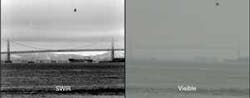
Lattice-matched InGaAs sensors operate in the NIR/SWIR band (0.7 to 1.7 microns), which lies between the visible (0.4 to 0.7 microns) and the thermal (2 to 12 microns) radiation bands of the electromagnetic spectrum. InGaAs sensor technology mostly detects reflected light rather than heat signatures. A SWIR camera captures images day and night, and especially during the dawn and dusk thermal crossover periods when thermal cameras have difficulty distinguishing targets against backgrounds at similar temperatures. InGaAs imagers are capable of generating a visible-like reflected light image quality, even during obscuration.
The DARPA Photon Counting Arrays (PCAR) and the Micro-Sensors for Imaging (MISI) programs seek to develop sensitive and compact, light-weight and low-power next-generation InGaAs imager technology.
The PCAR program goal is to reduce the InGaAs photodiode array dark current shot noise to a remarkably low level of no more than 0.5 nA/cm2, a 15-fold improvement over the current commercial material. At this dark current level, the imagers will have sufficient noise margin to operate at even higher temperatures without cooling or temperature stabilization.
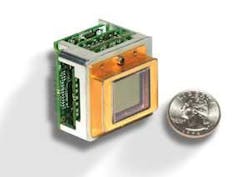
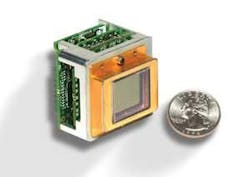
The MISI program leverages the PCAR material improvements to achieve a five-fold reduction in imager size, weight, and power consumption while quadrupling resolution and cutting noise more than half in comparison to the current commercial KT family of imagers. These programs are enhancing the key sensor attributes for small UAVs where the balancing act of sensor size, weight, and performance is most critical.
SWIR offers many advantages over traditional night-vision and thermal imaging technologies. Unlike traditional image intensifier night-vision equipment, compact InGaAs SWIR cameras can help provide warfighters with exceptional clarity to identify targets, in day and night conditions, from partial starlight to direct sunlight illumination, in fog, mist, haze, and even dust and smoke or when little or no heat is radiated.
The clear advantage of SWIR can be seen in typical daylight to starlight maritime scenes. Thermal imaging provides a good contrast between hot targets and the cool backgrounds, but SWIR works even when there is little thermal scene contrast. Capturing shadows and contrast in reflected light characteristic of SWIR images makes interpretation intuitively easier than with thermal images. SWIR imagery is an essential complement to thermal for positive target identification.
The ScanEagle UAV was developed as a low-cost, long-endurance autonomous unmanned aircraft to provide persistent ISR as well as flexible, rapid deployment for a variety of government and civilian applications. The compact, lightweight camera is able to operate at room-temperature and image in fog, haze, or rain during daytime or nighttime, making it particularly suited for maritime intelligence and surveillance from small platforms, such as the ScanEagle UAV.
David G. DAWES is manager of business development for DoD applications, and Martin H. Ettenberg is director of research, development, and business development, at Sensors Unlimited Inc., part of Goodrich Corp. in Princeton, N.J. Visit the company online at www.sensorsinc.com.
