CCD image sensors from e2v launched aboard NASA Kepler star-monitoring spacecraft
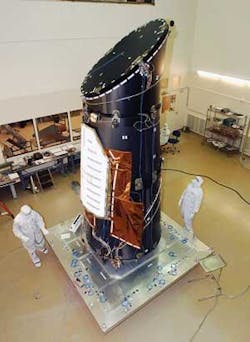
CHELMSFORD, England–Engineers at e2v Technologies plc in Chelmsford, England, are providing the CCD imaging sensor for the NASA Kepler spacecraft, which launched 6 March from Cape Canaveral, Fla., to monitor stars in Earth’s galaxy.
The CCD image sensors from e2v are part of a CCD camera system from Ball Aerospace & Technologies Corp. in Boulder, Colo.
From space, Kepler will simultaneously monitor more than 100,000 stars in the Milky Way Galaxy. It will observe sun-like stars, seeking to discover Earth-like planets whose orbits about their star are at distances where liquid water can exist, and where life could form.
“Kepler, with its large focal plane array, will let us observe over 100,000 stars simultaneously and discover as many as 100 earth like planets during the course of the mission,” says Margaret Frerking, Kepler’s deputy project manager from the NASA Jet Propulsion Laboratory (JPL) in Pasadena, Calif.
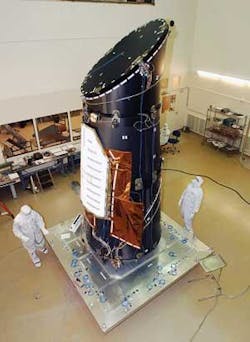
Ball Aerospace designed and built Kepler’s photometer, a 0.95-meter aperture, wide field-of-view Schmidt telescope, with a 1.4-meter primary mirror. With more than 95 megapixels, Kepler’s focal plane array of 42 e2v backside illuminated CCD90s forms the largest array of CCDs ever launched into space by NASA, e2v officials say.
“e2v’s imaging sensors are the heart of the Kepler mission,” says John Troeltzsch, Ball Aerospace program manager. “The CCDs will allow Kepler to detect Earthlike planets orbiting in the habitable zone around other stars and possibly answer the million dollar question, ‘Are we alone?’”
The CCDs are not used to take sharp pictures; the images are intentionally defocused to about 10 arc seconds to improve the photometric precision. CCD stands for charge coupled device.
The e2v CCD imaging sensor used for the Kepler mission has 2,200 by 1,044 active pixels; 27-micron size; and 28-by-55-millimeter image area. The devices are back thinned for spectral response across the visible and near-infrared range.
More information about the Kepler mission is online at kepler.nasa.gov. For more information contact e2v online at www.e2v.com.
