Electro-optics Brief

Physical Optics Corp.’s digital video recorder system to fly on Sikorsky helicopters
Officials at Sikorsky Aircraft Corp. in Stratford, Conn., selected the FAERITO Digital Video Recorder from Physical Optics Corp. (POC) in Torrance, Calif., to support its S-76C+ and S-76C++ customers with video flight recording, or DVRS (Digital Video Recorder System) capability–complementing existing flight data analysis and animation solutions. The DVRS suite provides the company with an end-to-end solution for advanced flight data recording, says Eric Hansen, senior program manager for the S-76 from Sikorsky. The agreement between POC and Sikorsky Aircraft stems originally from a Navy SBIR (Small Business Innovation Research) project for advanced flight data recording systems. The Federal Aviation Administration (FAA) granted an STC (Supplemental Type Certification) for this system late last year.

The system will permit operation of the S-76C+ and the S-76C++ helicopters in accordance with EASA JAR-OPS (Joint Aviation Requirement Operations) operating requirements. The POC crash survivable DVRS will be the first flight data recorder certified to the EURO CAE ED-112–the European Organization for Civil Aviation Equipment’s Minimum Operational Performance Specification for Crash Protected Airborne Recorder Systems standard–and compliant with both the FAA and EASA requirements. In addition to the current crash-survivable FAERITO Digital Video Recorder, POC is developing an Advanced Avionics Recorder for U.S. Navy aircraft.
CACI wins $40 million order to support U.S. Army forward looking infrared systems
CACI International Inc. in Arlington, Va., won a $40 million task order under the U.S. Army’s Strategic Services Sourcing (S3) contract vehicle to support the U.S. Army’s Product Manager Forward Looking Infrared (PM FLIR) and Night Vision and Electronic Sensors Directorate (NVESD). The award increases CACI’s business in the area of Army C4ISR (command, control, communications, computers, intelligence, surveillance, and reconnaissance). PM FLIR is responsible for the development, capabilities assessment, test and evaluation, production, and operational support of FLIR sensor-based systems for the Army and other DOD organizations. The office works closely with the Night Vision and Electronic Sensors Directorate to identify, invest in, develop, and switch technologies and systems that show the most potential for enhancing the effectiveness and survivability capabilities of the warfighter. The goal of PM FLIR is to enable “sensing beyond the visible” to reveal threats that might otherwise remain unseen or blended into the environment. CACI will provide engineering, logistics, and business operations support for the development, manufacture, and sustainment of FLIR systems.
BAE Systems seeker detects small missile in latest test
A BAE Systems seeker detected an incoming target representing a ballistic missile in the most recent test of the Terminal High Altitude Area Defense (THAAD) weapon system. The test, conducted in March by the U.S. Missile Defense Agency and THAAD prime contractor and systems integrator Lockheed Martin, examined how the interceptor and other THAAD system components detect and intercept a target missile. “The THAAD program demonstrated its tactical salvo capability, launching two THAAD interceptors,” says Bruce Whaley, seeker program manager at BAE Systems in Nashua, N.H. “As the flight test program continues, the targets become more challenging to detect and hit, and the engagement scenarios more complex.” The BAE Systems seeker detects infrared imagery from the warhead to guide the interceptor to its target. THAAD intercept testing will continue through 2011. THAAD is designed to defend U.S. and allied soldiers, military assets, and population centers from the threat of ballistic-missile attacks, destroying enemy warheads and missiles through direct “hit-to-kill” targeting.
Dilas introduces fiber-coupled diode laser bar
Dilas in Mainz, Germany, unveiled a high-power, fiber-coupled module that enables unpolarized optical output laser beams. Within the fiber-coupled module architecture, Dilas uses a polarization scrambler random polarization for applications like a military laser.
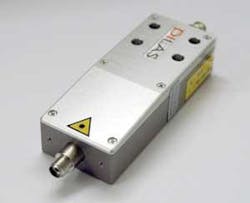
With a degree of polarization at less than 0.1, this product is for diode-pumped solid-state laser manufacturers of systems like a laser weapon. Standard modules are available with power as strong as 40 watts at 808, 880, 915, 940, and 980 nanometers with a numerical aperture of 0.22 from 400-micron core fibers.
