Northrop Grumman-built laser demonstrates long-duration, lethal lasing onboard Airborne Laser aircraft
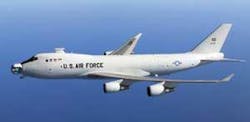
REDONDO BEACH, Calif.–Northrop Grumman Corp.’s high-energy laser fired several long-duration blasts onboard the U.S. Missile Defense Agency’s (MDA) Airborne Laser (ABL) during intensive ground tests in February.
Lasting as long as three seconds each, the lethal-power military laser firings were conducted with the goal of tuning the megawatt-class laser by adjusting and balancing the mixture of chemicals in the laser weapon that fuel its engine for peak operating efficiency.
These settings can be used for future testing, including the planned shootdown of a ballistic missile with laser weapons scheduled to occur later in the year, according to company officials.
“The hallmarks of these latest firings are durability and repeatability,” explains Dan Wildt, vice president of Directed Energy Systems for the Northrop Grumman Aerospace Systems sector in Redondo Beach, Calif. “The duration of each firing of the megawatt-class laser was limited only by ground equipment.”
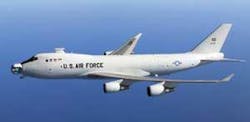
Long-duration operations of the chemical oxygen iodine laser (COIL) followed first light of the high-energy laser through ABL’s onboard beam control and fire control (BC/FC) system in the aircraft’s hangar at Edwards Air Force Base, Calif., in November 2008.
The operations were conducted by MDA, ABL prime contractor Boeing, and Northrop Grumman.
For long-duration laser operations, the megawatt-class laser was fired into a calorimeter onboard the aircraft. The cal-orimeter is a test instrument that both captures and measures beam power.
Each long-duration test provided the necessary data used to quickly evaluate and ‘tune’ the megawatt-class laser for peak operation.
The tuned, high-power laser is on schedule to be fired through the on-board BC/FC system into a range simulator to complete ABL’s weapon system ground testing phase in the next few weeks. After completion of the firing, the ABL system will be cleared to begin weapon system flight tests.
The ABL aircraft consists of a modified Boeing 747-400F, the back half of which holds the high-energy laser, designed and built by Northrop Grumman.
Before being installed, the high-energy laser completed rigorous ground testing in a laboratory at Edwards AFB.
The ABL aircraft’s front half contains the beam control/fire control system, which was designed and developed by Lockheed Martin. The aircraft’s battle management system was designed and delivered by The Boeing Company.
