Boeing looks to Vision Systems for helmet-mounted displays for jet fighter aircraft pilots
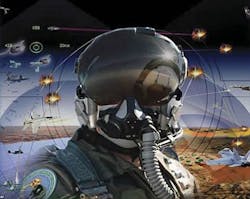
SAN JOSE, Calif., 13 May 2012. Combat aircraft designers at the Boeing Co.Defense, Space & Security segment in St. Louis needed helmet-mounted displays for jet fighters. They found their solution from Vision Systems International LLC (VSI) in San Jose, Calif. Boeing awarded VSI a $32 million contract for the Joint Helmet Mounted Cueing System (JHMCS) for U.S. Navy and Air Force jet fighter pilots, as well as for combat aircraft operating in Finland, Australia, Belgium, Canada, and Switzerland.
This JHMCS buy is for the Boeing F/A-18 Hornet strike fighter and the Lockheed Martin F-16 jet fighter. VSI will provide Boeing with the JHMCS full-rate production lot eight. Deliveries are to be through 2013.
The JHMCS enables pilots "to maintain eyes-out while viewing critical information on the helmet visor," says VLSI President Phil King. The JHMCS helps jet fighter pilots fire the AIM-9X Sidewinder heat-seeking air-to-air missile as part of the High-Off-BoreSight (HOBS) system that enables pilots to aim onboard weapons at enemy aircraft by pointing their heads at the targets.
In an air-to-ground role, pilots use the JHMCS with targeting sensors and smart weapons to attack surface targets. In all roles, images and symbology are projected onto the JHMCS visor to provide the pilot with aircraft status information, targeting data, weapons status, and threat warning information no matter where the pilot is looking.
The idea is to enhance pilot situation awareness throughout the mission. In a dual-seat aircraft, each crew member can wear a JHMCS helmet, perform operations independently of each other, and have continuous awareness of where the other crew member is looking, Boeing officials say.
The JHMCS has a magnetic helmet-mounted tracker determines where the pilot's head is pointed, and combines that capability with a miniature display system on the helmet's visor. The head tracker and visor display can aim sensors and weapons wherever the pilot is looking.
The JHMCS can the pilot airspeed, altitude, target range, and other information while the pilot looks outside of the cockpit. To attack a ground target, the pilot can acquire the target with a sensor and note it's location on the helmet display, or use the helmet display to cue sensors and weapons to a visually detected ground target.
Since targets may be located at high-off-boresight line-of-sight locations in relation to the shooter, the system delivers a short-range intercept envelope that is larger than other air-to-air weapons. The helmet also can be datalinked to hand visually detected targets from one aircraft to another.
VSI is a joint venture among Elbit Systems of America, and Rockwell Collins, and has produced more than 4,500 JHMCS for the F-15, F-16, and F/A-18 aircraft.
For more information contact VSI online at www.vsi-hmcs.com, or Boeing Defense, Space & Security online at www.boeing.com/bds.
Follow Military & Aerospace Electronics and Avionics Intelligence news updates on Twitter
