MEMS and nanotechnology maturing for certain military applications, yet its potential is still immense
Product Intelligence Report, 30 May 2012.Micro electro mechanical systems (MEMS) and nanotechnology have come a long way over the past several decades, yet the potential of these technologies seems limited only by the imagination. Today MEMS and nanotechnology are fielded in micro gyros for navigation and positioning, microbolometers for infrared imaging, and micro mirrors for steering laser beams.
The future of MEMS and nanotechnology is particularly exciting, experts say. RF MEMS and nanotechnology could lead to major breakthroughs in aerospace and defense applications such as satellite communications at speeds in excess of 100 GHz, and electronically steerable RF phase shifters for true time delay.
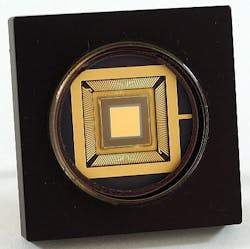
The photo above, from Boston Micromachines, shows the company's Multi-DM mirror.
In other kinds of applications, researchers are looking at using MEMS and nanotechnology to emulate the tiny hair follicles in animals such as the gecko lizard that enable the creatures to walk on smooth horizontal surfaces and even upside down without falling.
This kind of MEMS and nanotechnology application could lead to micro unmanned vehicles for intelligence, surveillance, and reconnaissance (ISR) that would blend in with insects and other wildlife and be virtually undetectable. Better still, this kind of technology would enable such a micro spy vehicle to remain stuck on a wall even when its power shuts off.
Once considered among the hottest technology fields, MEMS and nanotechnology almost seemed magic in its potential, but the reality is MEMS and nano simply are extensions of microelectronics knowledge gained over the past half century and applied to non-traditional fabrication methods.
"MEMS maturity depends on the application," explains Theodore Chi, director of marketing and sales at Innovative Microtechnology Inc. in Santa Barbara, Calif. "MEMS technology is not an industry; rather it is what we have learned over the past 50 years in microelectronics and applying it to processes other than CMOS."
The MEMS-processing technologies that are considered mature involve micro gyros and accelerometers for computer games, smart phones, and automobile crash sensors, Chi says. These kinds of devices enable smart phones to flip automatically from horizontal to vertical screen view depending on how the user is holding the device.
Breakthroughs yet to happen might involve gecko-foot technology for tiny walking unmanned vehicles, and RF MEMS and nanotechnology for advanced satellite communications, Chi says.
Boston Micromachines Corp. in Cambridge, Mass., specializes in MEMS deformable mirror technology applicable to adaptive optics to help focus laser beams, as well as to steer laser beams. The company also applies its MEMS deformable mirror technology to diffraction elements that help turn laser beams on and off at fast speeds.
The ability to turn lasers on and off at extremely fast speeds is key to laser communications, says Michael Feinberg, director of sales and marketing at Boston Micromachines, which makes a MEMS optical modulator that varies the intensity of a laser beam. Unpowered the MEMS optical modulator technology acts as a mirror, and with power it acts as a laser-scattering diffraction element.
Laser communications will be a key aerospace and defense technology of the future because it is efficient, sends data at extremely fast speeds, and is difficult for an adversary to intercept or jam because lasers are focused energy with little scatter, unlike radio waves that broadcast widely to general areas.
Using MEMS and nano technology to fabricate extremely tiny deformable mirrors can yield technology that is small, lightweight, and consumes little power, which could be a key enabling technology for laser communications devices on small unmanned vehicles and handheld devices.
Sometimes MEMS and nanotechnology pertains not only to tiny mechanical devices, but to complex powders, as well, that forms the building blocks for new materials with aerospace and defense applications.
Researchers at the U.S. Army's Picatinny Arsenal, N.J., are using nanotechnology to craft nanopowders to build rounded plates, and eventually may lead to improved weapons penetrators for large- and small-caliber projectiles, warhead liners, and improved missile domes.
Picatinny researchers also are investigating the use of nanopowders for crafting a new generation of artillery shells in which the shell casing actually is an explosive, reactive material that scatters and burns when the artillery round impacts. This has the potential to create an artillery round with unprecedented destructive power.
In the past, Picatinny researchers have looked at the possibility of using nanopowders in smart paint that has the potential to change colors when subjected to electrical current to create an adaptable camouflage coating.
MEMS and nanotechnology companies
Akustica Inc.
Pittsburgh
412-390-1730
www.akustica.com
Altair Nanotechnologies Inc.
Reno, Nev.
775-856-2500
www.altairnano.com
American Sun Components (ASC)
Tamarac, Fla.
954-718-2950
www.americansuncomponents.com
Analog Devices Inc.
Norwood, Mass.
781-329-4700
www.analog.com
Bosch Sensortec GmbH
Reutlingen, Germany
+49 7121 3535-900
www.bosch-sensortec.com
Boston Micromachines Corp.
Cambridge, Mass.
617-868-4178
www.bostonmicromachines.com
Cohu Inc.
Poway, Calif.
858-848-8100
www.cohu.com
Colibrys
Neuchâtel, Switzerland
+41 32 720 58 11
www.colibrys.ch
DelfMEMS
Villeneuva d'Ascq, France
+33 3 20 05 05 45
www.delfmems.com
Global Access Unlimited Inc.
Clearwater, Fla.
727-538-2528
www.gauinc.com
Innovative Micro Technology
Santa Barbara, Calif.
805-681-2800
www.imtmems.com
Internix Inc.
Tokyo, Japan
www.internix.co.jp
Kebaili Corp.
Irvine, Calif.
949-494-5892
www.kebaili.com
Kionix Inc.
Ithaca, N.Y.
607-257-1080
www.kionix.com
Lux Research
Boston
617-502-5300
www.luxresearchinc.com
MEMSIC Inc.
Andover, Mass.
978-738-0900
www.memsic.com
Microflown Technologies
Arnhem, The Netherlands
+31 (0) 88 0010 800
www.microflown.com
mPhase Technologies Inc.
Little Falls, N.J.
973-256-3737
www.mPhaseTech.com
Nevada Nanotech Systems Inc.
Sparks, Nev.
408-313-1990
www.nevadanano.com
Panasonic Electric Works
New Providence, N.J.
1-908-464-3550
http://pewa.panasonic.com
Preciseley Microtechnology Corp.
Edmonton, Alberta
780 902 4137
www.preciseley.com
Qualcomm MEMS Technologies Inc.
San Diego
858-651-6073
www.mirasoldisplays.com
Samtec Microelectronics
Colorado Springs, Colo.
719-592-9100
www.aspentechnologies.com
Sand 9 Inc.
Cambridge, Mass.
617-453-2451
www.sand9.com
Sercalo Microtechnology Ltd.
Neuchâtel, Switzerland
032 732 15 20
www.sercalo.com
Siargo Ltd.
Santa Clara, Calif.
408-969-0368
www.siargo.com
Silicon Designs Inc.
Kirkland, Wash.
425-391-8329
www.silicondesigns.com
Silicon Light Machines
Sunnyvale, Calif.
408-240-4700
www.siliconlight.com
STMicroelectronics Inc.
Geneva, Switzerland
+41 22 929 29 88
www.st.com
Summit Instruments Inc.
Akron, Ohio
330-659-3312
www.summitinstruments.com
Tanner Research Inc.
Monrovia, Calif.
626-471-9700
www.tanner.com
