i-Pad-like capacitive touchscreen technology may be coming soon to an airline flight deck near you
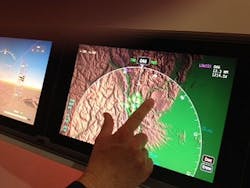
THE FARNBOROUGH BLOG, 11 July 2012. Today's airline and general-aviation pilots might not be ready for iPad-like touchscreens in the cockpit, but tomorrow's pilots are, and that's why Barco Inc. in Duluth, Ga., is developing capacitive touchscreen technology for tomorrow's large-aircraft flight decks.
Barco, the Belgian display technology giant with U.S. offices in Duluth, Ga., is at the Farnborough International Airshow this week encouraging pilots, avionics integrators, and others to get their hands on capacitive touchscreen technology configured as avionics displays.
A capacitive touchscreen is what you see on the iPad, iPhone, and other smartphone technologies -- you know, the one where you progress screens with the sweep of a finger, and enlarge the image by widening you fingers while touching the screen.
Like it or not, this is the kind of touchscreen technology that most people are getting used to today, and has the potential not only to dominate future smartphone and computer tablet applications, but also to be standard equipment in many airliner cockpits.
Touchscreen technology isn't new for the most modern aircraft. The F-35 joint strike fighter, in fact, has touchscreen technology in the cockpit provided by Barco, but it's infrared touchscreen technology so that it works reliably with a gloved hand. Infrared touchscreens are out of the price ranges of most avionics designers.
Capacitive touchscreen technology, however, is not. This display design, in fact, is becoming less and less expensive as smartphones and computer tablets grow in popularity and become ubiquitous in our culture. Take a look, and you see them everywhere -- on the street, on buses and trains, at airports, and in cars.
A capacitive touchscreen has an insulator such as glass, coated with a transparent conductor such as indium tin oxide. Since the human body is an electrical conductor, a finger touching the surface distorts the screen's electrostatic field that is measurable as a change in capacitance. The location of the distortion goes to the screen's controller for processing, which results in controlling the screen.
Capacitive touchscreens only work, however, with an ungloved finger, or with special pointers or specially equipped gloves.
Barco is providing touchscreen displays for relatively small aircraft used for normal, utility, aerobatic, and commuter applications, or the so-called FAA Type 23 aircraft. Larger aircraft, however, offer a potentially lucrative market for this technology.
It's the FAA Type 25 aircraft -- jets with 10 or more seats, or propeller-driven airplanes with more than 19 seats -- that Barco officials are eying for future avionics applications of capacitive touchscreen technology.
Reach out and touch Barco's capacitive screens on display at Farnborough, and immediately they don't feel quite the same as a smartphone. There's a slight time lag between touch and action, and Barco experts explain that lag is there for a purpose.
A momentary inadvertent touch in the cockpit should not change a display, which could compromise safety or operation of the aircraft. Instead, Barco engineers have written the touchscreen software so that only an intentional touch will change the display.
This approach also could be effective in cockpits with large amounts of vibration, such as those in helicopters.
So the iPad-like capacitive touchscreen display may be coming to an airliner near you, and just in time for the next generation of aircraft pilots who have grown up with the smartphone.
For more information contact Barco online at www.barco.com, or the Farnborough International Airshow at www.farnborough.com. Also follow Military & Aerospace Electronics and Avionics Intelligence daily Farnborough show coverage online at www.militaryaerospace.com/farnborough-report.
Follow Military & Aerospace Electronics and Avionics Intelligence news updates on Twitter
