Northrop Grumman to design electronic controls for launch systems on ballistic missile submarines
Key Highlights
Questions and answers:
- What is the purpose of Northrop Grumman’s $120 million contract with the U.S. Navy? To provide long-lead materials for the Columbia Development Launcher Program, which will support the missile launch systems aboard future Columbia-class ballistic missile submarines.
- What role do long-lead materials play in the Columbia Development Launcher Program? Long-lead materials are difficult or time-consuming to obtain, so funding them early ensures the overall submarine production schedule stays on track.
- How does the Columbia-class submarine differ from the Ohio-class it will replace? Each Columbia-class submarine will have 16 missile launch tubes instead of 24, emphasizing reliability and modernized systems for the Navy’s next-generation nuclear deterrent fleet.
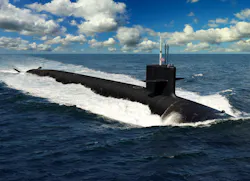
WASHINGTON – Ballistic missile launcher experts at Northrop Grumman Corp. will provide long-lead materials for the ballistic missile launch systems aboard the future U.S. Navy Columbia-class missile submarines under terms of a $120 million contract announced last month.
Officials of the Navy Strategic Systems Programs office in Washington are asking the Northrop Grumman Marine Systems segment in Sunnyvale, Calif., for long-lead materials for the Columbia Development Launcher Program (CDLP).
Long-lead items either are difficult and time-consuming to obtain, and are funded early in the design process to keep overall production on schedule. Contracts to build the CDLP will come later.
The CDLP project covers development, production, and support of the launch subsystem for the Trident D5/D5LE2 missiles within the Common Missile Compartment (CMC) on future U.S. Columbia-class and United Kingdom Dreadnought-class nuclear-powered nuclear ballistic missile submarines. Northrop Grumman's work centers on producing launcher subsystem hardware.
Next-gen missile boat
The Columbia-class submarine is Navy's next-generation ballistic missile submarine to replace the aging Ohio-class fleet, and will carry Trident II D5 nuclear missiles. Construction of the lead boat, USS District of Columbia (SSBN 826), is at least 60 percent completed, and should deploy in 2030. Construction is in progress on the second boat of the class, the USS Wisconsin (SSBN 827).
Construction of the United Kingdom HMS Dreadnought submarine began in 2016, and should be deployed in the early 2030s. The CDLP design is common to the Columbia-class and Dreadnought-class ballistic missile submarines.
Northrop Grumman manufactures launcher subsystems compatible with Trident II (D5LE) missiles, including 16 launch tubes per Columbia submarine versus 24 on Ohio-class boats. Production emphasizes reliability for 12 planned Columbia-class submarines.
Electronic controls
Launcher systems typically integrate electronic controls for valve actuation, pressure monitoring, sequencing, fire-control interfaces, and sensors for gas management and missile egress in underwater launches.
Launcher subsystems include mechanical and electronic components for missile tube operations; controls for generating and regulating expulsion gases; electronic valve actuators control; sensors real-time monitoring of pressure, alignment, and status; and control interfaces that link to the submarine's fire control and navigation systems.
On this contract Northrop Grumman will do the work in Sunnyvale, Calif., and should be finished by May 2028. For more information contact Northrop Grumman Marine Systems online at www.northropgrumman.com/what-we-do/mission-solutions/naval-control-and-management-systems, or the Navy Strategic Systems Programs office at www.ssp.navy.mil.
