Air Force seeks to blend electronic warfare (EW) and cyber warfare to counter uncrewed aircraft
Key Highlights
Questions and answers:
- What is the main objective of the Air Force Research Laboratory’s M-FAT program? To blend electronic warfare (EW) and cyber warfare technologies to counter small uncrewed enemy aircraft by disrupting their command-and-control links while minimizing collateral damage.
- What kinds of technologies does the M-FAT program seek to advance? It focuses on improvements in EW, cyberspace operations, automated command and control, AI-driven decision-making, sensor fusion, and the development of low-cost autonomous interceptors with integrated cyber and EW capabilities.
- How much funding is planned for the M-FAT program, and through what year does it extend? The program is expected to fund about $490 million through 2030, with several contract award opportunities scheduled between 2026 and 2030.
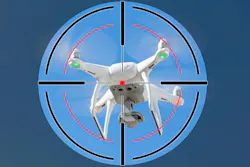
ROME, N.Y. – U.S. Air Force researchers are asking industry to blend electronic warfare (EW) and cyber warfare to counter enemy small uncrewed aircraft by disrupting their command-and-control links.
Officials of the Air Force Research Laboratory Information Directorate in Rome, N.Y., have issued a broad agency announcement (FA8750-25-S-7004) for the Multi-Domain Force Applications and Traffic Management for Unmanned Aircraft Systems (M-FAT) program.
M-FAT seeks advanced in EW, cyberspace operations, command and control automation and autonomy, low-collateral defeat , low-collateral effect interceptors, blue force interceptors, and communications.
One goal is to blur the line between EW and cyber warfare by developing enabling technologies for cyber attacks of small uncrewed aircraft command and control links for counter uncrewed aircraft operations.
Low collateral damage
This includes improving system resiliency in contested environments and placing a priority on low collateral damage, and to automate responses to enemy small uncrewed aircraft -- especially swarm attacks -- through artificial intelligence (AI), machine learning, sensor fusion, and automated decision-making.
Research could lead to low-cost, autonomous interceptors with integrated EW and cyber warfare capabilities and other anti enemy small uncrewed aircraft payloads.
Researchers also want to improve detection, identification, and tracking sensors, and develop a library for storing and indexing cyber warfare effects.
In parallel, M-FAT seeks to improve uncrewed aircraft traffic management systems that work together with existing air traffic control systems to enable safe integration of uncrewed aircraft into the airspace.
Enhanced communications
Finally, communication systems will be enhanced through advanced modeling and simulation, development of resilient waveforms and networking protocols for swarm operations, and integration of AI for network optimization and spectrum management.
M-FAT funding through 2030 should be about $490 million, and several contract awards are expected. Companies interested should submit white papers no later than 21 Aug. 2026 for 2027 contracts; by 31 Aug. 2027 for 2028 contracts; by 31 Aug. 2028 for 2029 contracts; and by 31 Aug. 2029 for 2030 contracts.
Email white papers, questions, or concerns to the Air Force Tristen Carrig at [email protected], and to Peter Fitzgerald at [email protected].
Email business questions to the Air Force's Amber Buckley at [email protected]. More information is online at https://sam.gov/workspace/contract/opp/5892686931194bb08777f56ab585e7c0/view.
