RTX's BBN demonstrates self-healing tactical communications system for contested environments
Key Highlights
- The system automatically switches communication pathways to maintain connectivity during jamming or network failures.
- Supports multiple communication modes including satellite links, tactical radios, and commercial networks for versatile deployment.
- Features a compact, low SWaP design suitable for power- and space-constrained military platforms.
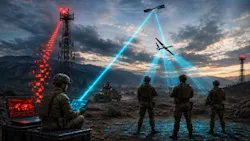
CAMBRIDGE, Mass. - RTX business unit BBN Technologies has demonstrated a self-healing communications system designed to maintain secure data connectivity for combat air support operations even when networks are jammed, fragmented, or unavailable.
The effort, funded by the Air Force Research Laboratory, demonstrated the Primary, Alternate, Contingency, and Emergency for Agile Combat Employment architecture, known as PACE4ACE. The system is designed to automatically route traffic across multiple communications pathways without operator intervention.
PACE4ACE can operate across satellite communications links, tactical radios, and other military and commercial communications networks. During the demonstration, the system automatically shifted traffic to alternate waveforms when high-capacity links were disrupted by jamming, enabling continuous operation of Open Mission Systems and Team Awareness Kit applications across four geographically dispersed sites.
Contract background
The work is being conducted under contract FA8750-20-C-0544, a research-and-development effort awarded by the Air Force Research Laboratory in 2020 to Raytheon BBN Technologies in Cambridge, Mass. Public contract records identify the program as Learning in Agile Networks with TAK-Enabled Robust Nodes (LANTERN). The award reportedly carries a potential value exceeding $10 million and runs through August 2026.
RTX says the architecture is intended to support the U.S. Air Force Agile Combat Employment operational concept, which emphasizes dispersed operations in contested environments while maintaining resilient command-and-control and situational awareness capabilities.
The architecture is designed not only as a communications backup capability but also as a dynamic networking layer that coordinates routing across multiple communications bearers. The approach aligns with broader Pentagon efforts to develop resilient, distributed tactical networking architectures capable of operating in contested electromagnetic environments.
Related: Navy taps Raytheon for M-Code upgrade to JPALS precision landing system
According to the company, the system features a compact, low size, weight, and power (SWaP) architecture intended for power- and space-constrained platforms. Other capabilities include multiband communications support, dynamic real-time routing, and plug-and-play integration with existing mission systems.
"PACE4ACE helps ensure critical data never disappears, even under jamming," said Dr. Sam Nelson, principal investigator at RTX BBN Technologies. "The network self-heals, so crews can focus on the mission instead of troubleshooting communications."
Long-range radios used during the demonstration were supplied by Institute for Human & Machine Cognition, while high-frequency communications support was provided by Collins Aerospace, an RTX business unit with participation from its Ottawa operation.
The work is supported by the Air Force Research Laboratory and the U.S. Army Aviation and Missile Command under contract.
About the Author
Jamie Whitney
Editor-in-Chief
Jamie Whitney joined the staff of Military & Aerospace Electronics in 2018 and oversees editorial content and produces news and features for Military & Aerospace Electronics, attends industry events, produces Webcasts, and oversees print production of Military & Aerospace Electronics.
Related
Voice Your Opinion!
To join the conversation, and become an exclusive member of Military Aerospace, create an account today!
 Leaders Logo
Leaders relevant to this article: