Remcom develops wireless modeling for Artemis lunar spacesuits and vehicles
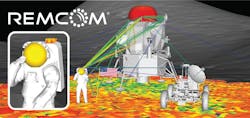
Q: What is the purpose of Remcom’s new NASA contract? A: The Phase I SBIR contract funds development of enhanced wireless channel modeling for antennas on astronaut spacesuits and lunar vehicles to ensure reliable communications on the Moon.
Q: How does this work support the Artemis mission? A: It helps engineers design and verify robust device-to-device and vehicle-to-astronaut links, addressing challenges from complex layered spacesuit materials and lunar surface operations.
Q: What technology is being used in the project? A: Remcom’s Wireless InSite 3D Wireless Prediction Software will model near-field and far-field antenna behavior using Huygens surfaces, while acceleration methods reduce simulation runtimes by one to two orders of magnitude.
STATE COLLEGE, Pa. - Remcom in State College, Pa. announced it has received a new Small Business Innovation Research (SBIR) Phase I contract from the National Aeronautics and Space Administration (NASA) to develop enhanced wireless channel modeling capabilities for antennas mounted on astronaut spacesuits and lunar vehicles.
Remcom says the contract builds on earlier work supporting NASA’s Space Communications and Navigation program and Artemis lunar exploration missions. Artemis is NASA’s program to return astronauts to the Moon for the first time since Apollo. Artemis I, an uncrewed test flight in 2022, successfully demonstrated the Space Launch System rocket and Orion spacecraft. Artemis II is planned as the first crewed flight, sending astronauts around the Moon.
The project supports the Artemis mission by enhancing communications for astronauts using next-generation spacesuits. NASA’s new Exploration Extravehicular Mobility Unit, or xEMU, features improved mobility, better life-support systems, and pressure capacity up to 8 psi. These suits overcome the limitations of older International Space Station (ISS) suits by incorporating flexible joints, bearings, and increased overhead reach for lunar surface activities.
Wireless tech
Remcom’s work utilizes enhancements in Wireless InSite 3D Wireless Prediction Software to tackle challenges posed by layered suit materials and their effect on antenna radiation. Wireless InSite will use Huygens surfaces to combine near-field and far-field antenna behaviors around astronauts and lunar structures, supporting the analysis of antenna placements and protocols like 3GPP sidelink for device-to-device communications. Acceleration techniques will cut simulation runtimes by up to two orders of magnitude.
"Modeling antennas in close proximity to complex structures like spacesuits introduces new electromagnetic challenges that are not well addressed by traditional simulation approaches," said Greg Skidmore, Remcom’s director of propagation software and program manager. "This contract provides the opportunity to prototype unique solutions that ensure astronauts stay connected, whether they’re exploring craters or conducting operations outside line-of-sight."
About the Author
Jamie Whitney
Senior Editor
Jamie Whitney joined the staff of Military & Aerospace Electronics in 2018 and oversees editorial content and produces news and features for Military & Aerospace Electronics, attends industry events, produces Webcasts, and oversees print production of Military & Aerospace Electronics.
Voice Your Opinion!
To join the conversation, and become an exclusive member of Military Aerospace, create an account today!

Leaders relevant to this article: