Mynaric to test laser communications terminals in ESA HydRON optical network demonstrations
Key Highlights
- Mynaric will test laser communication terminals in orbit as part of ESA's HydRON demonstration system.
- The project aims to establish a high-capacity, interference-free optical data relay network supporting global connectivity.
- HydRON's multi-orbit architecture will explore optical links across Low Earth Orbit and Medium Earth Orbit regimes.
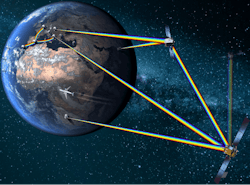
MUNICH - Mynaric in Munich has been awarded a demonstration project by the European Space Agency (ESA) under Element 3 of its HydRON (High Throughput Optical Network) Demonstration System to support testing of laser communications technologies in orbit.
The work is part of the HydRON User Segment, which will focus on in-orbit testing, validation, and interoperability demonstrations of laser communications terminals within ESA’s emerging optical data relay network. The HydRON network is intended to serve as a foundation for future European space communications infrastructure.
"The HydRON Demonstration System provides a unique opportunity to test and refine laser communications technologies in an operational network environment," said Joachim Horwath, chief technology officer at Mynaric. "Through these demonstrations, we can further mature our technology, address interoperability requirements, and continue expanding our product portfolio to meet the evolving needs of multi-orbit and multi-mission space networks."
Related: NASA's laser communications tech, science experiment safely in space
HydRON is part of ESA’s Optical and Quantum Communications - ScyLight program, which focuses on advancing optical and quantum communications technologies for satellite networks. The initiative aims to establish a high-capacity optical data relay infrastructure in space and provide ESA member states and industry with an in-orbit test environment for optical communications technologies.
Under Element 3, Mynaric will contribute laser communications technology for demonstrations supporting validation of optical links and network integration concepts under operational conditions. The work may include evaluation of new terminal concepts, preparation for future hosted payload opportunities, and support for emerging service applications linked to the HydRON network.
Related: DLR demonstrates airborne quantum communication link
"The selection of Mynaric for the HydRON User Segment activities reflects ESA’s confidence in our technological expertise and our ability to execute on complex optical communications programs," said Andreas Reif, chief restructuring officer of Mynaric. "It represents an important milestone as we continue to strengthen the company, expand our role within Europe’s space infrastructure, and position Mynaric for sustainable growth as a key contributor to future European and global space and defense networks."
High-capacity optical
HydRON is designed to demonstrate high-capacity optical communications capable of terabit-per-second data rates with minimal interference. The architecture is intended to provide scalable connectivity and support global communications, including in remote regions.
"With HydRON, we’re aiming for a world-first optical network that allows for fast, terabit-per-second capacity communications with no interference," said Laurent Jaffart, director of resilience, navigation, and connectivity at ESA. "The project will offer a scalable capacity that will allow for reliable and seamless global connectivity, designed to benefit even the most remote of locations. In the current geopolitical climate, resilient communications are more important than ever, and with Mynaric, we’re taking the next step in delivering an infrastructure that promotes interoperability, reliability, and security for a wide range of satellite communication services."
The project also supports HydRON’s multi-orbit architecture, exploring optical communications links across different orbital regimes, including Low Earth Orbit and Medium Earth Orbit, in support of future networked space systems.
Mynaric previously received a contract under HydRON Element 2 to help establish a satellite collector in low Earth orbit that connects multiple orbital layers using optical technology. In that phase, the company is developing and supplying laser communications terminals for both space and ground segments to support multi-orbit connectivity and testing of different data rates.
About the Author
Jamie Whitney
Editor-in-Chief
Jamie Whitney joined the staff of Military & Aerospace Electronics in 2018 and oversees editorial content and produces news and features for Military & Aerospace Electronics, attends industry events, produces Webcasts, and oversees print production of Military & Aerospace Electronics.
Related
Voice Your Opinion!
To join the conversation, and become an exclusive member of Military Aerospace, create an account today!
 Leaders Logo
Leaders relevant to this article: