Artemis II tests laser communications, delivers high-speed video from cislunar space
Key Highlights
- Optical communication hardware enabled high-definition video transmission during NASA's Artemis II mission from over 200,000 miles away.
- Laser-based data links provide higher throughput than traditional radio-frequency systems, supporting increased telemetry and imaging needs.
- Ground stations in California, New Mexico, and Australia collaborated to maintain continuous data flow, demonstrating flexible, distributed network capabilities.
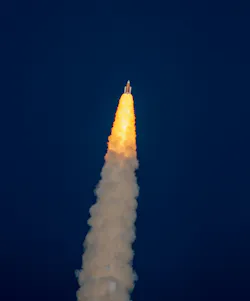
ADRIAN, Mich. – Los Angeles-based Observable Space and Michigan-based Quantum Opus said they contributed optical communication hardware that allowed high-definition video during NASA’s Artemis II mission. The work points to a shift toward laser-based data links for deep-space communications.
The ground segment combined optical tracking with high-sensitivity photon detection. A telescope locked onto Orion’s laser signal from more than 200,000 miles away, maintaining the ideal alignment required for optical links. Superconducting detectors then converted incoming photons into a stable data stream.
Ground stations in California and New Mexico received the signal, with a Canberra site extending coverage and reaching data rates up to 260 megabits per second. The results show that optical systems can deliver higher throughput than traditional radio-frequency links.
Laser links from lunar distance
Unlike radio-frequency communications, which run up against spectrum and bandwidth limits, optical systems transmit data using infrared laser signals.
These signals carry encoded information through rapid pulses, packing far more data into a narrower transmission path. That added capacity helps meet growing demand for telemetry, imaging, and video from future missions.
Expanding ground network coverage
The demonstration also showed how a more distributed set of ground stations can keep the connection going. As the Earth rotated and U.S.-based sites moved out of view, the Australian station picked up the link and avoided gaps in coverage.
That kind of handoff highlights a move toward more flexible ground architectures, in which multiple sites share the load to support continuous data flow. Over time, that could reduce reliance on a smaller number of large facilities and open the door to a wider network of lower-cost terminals.
The Artemis II test offers an early look at how optical communications could become part of routine operations, especially as NASA prepares for sustained activity in cislunar space and future missions beyond.
