Where faster signal timing could matter in defense electronics
Key Highlights
- IL demonstrates single-cycle signal alignment and accurate tracking of rapid timing changes in silicon tests, promising faster system responses.
- Reducing electronic delays can improve signal reacquisition, sensing accuracy, and information sharing in contested spectrum and electronic warfare scenarios.
- The technology supports phased array calibration, distributed sensing, and edge computing by enabling quicker data availability and processing.
- Next steps include integrating IL into complete wireless systems, testing under realistic conditions, and comparing performance with conventional designs.

NASHUA, N.H. — Defense systems increasingly rely on sensors, radios and other electronics to exchange information across distributed networks. When a signal changes or returns after an interruption, the electronics handling it need time to realign. That delay happens before usable information can move to other parts of the system.
The effect can matter when a radio changes frequencies, a sensor tracks a moving target or a communications link returns after an interruption. Reducing the time electronics spend adjusting could help information move through those systems sooner.
One approach under development changes how that signal alignment happens at the chip level. Gain ICs has developed the Instantaneous Loop (IL), an architecture designed to respond to timing changes differently from conventional phase-locked loops. Silicon testing showed alignment within one reference cycle and tracking through rapid timing changes without observed amplification or progressive buildup of timing errors under the tested conditions.
Those measurements remain at the component level. Testing in complete radios, wireless links and other representative hardware will determine whether the measured response produces the same advantages at the system level.
Timing affects different systems in different ways
The effect of faster signal alignment would depend on the system using it. Radios, sensors and antenna arrays handle signals differently, but each can encounter periods when electronics have to adjust to changing inputs or operating conditions. Testing in representative hardware would show whether reducing that adjustment time can speed communications recovery, improve sensing or deliver usable information sooner.
Senior military leaders are describing a force that must operate through disruption, coordinate across distributed systems, share information among military, allied, and commercial participants, and increasingly sense, decide, and act at machine speed. The Department of the Air Force has emphasized resilient architectures and distributed decision-making under degraded command and control, while the Space Force describes interoperability, the ability of different systems to work together, and information sharing as capabilities that must be integrated by design. [1,7,8]
Meeting those requirements will demand advances in software, AI, computing, networks, and autonomy. It will also require electronics capable of supporting the speed and coordination those systems demand.
IL offers an advanced foundational timing architecture for the radios, sensors, antenna arrays, and communications systems through which next-generation defense infrastructure receives and exchanges information. The development objective is targeted integration into existing or planned systems, preserving established interfaces and surrounding mission infrastructure wherever feasible.
Staged hardware testing would establish compatibility, identify necessary design changes, and reduce uncertainty before broader adoption. The mission opportunity is to translate its demonstrated single-cycle alignment and accurate signal tracking into faster communications recovery, more responsive sensing, and earlier delivery of usable information, helping warfighters and autonomous systems restore coordination and sustain mission execution through disruption.
-
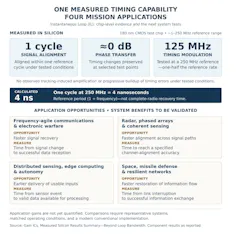
Frequency-agile communications and electronic warfare. Radios operating in contested spectrum must change operating frequencies, reconnect after interruption, and exploit brief opportunities to communicate. IL demonstrated alignment within one signal cycle under the tested conditions. Modeling predicts that this rapid, stable response will shorten the electronics' adjustment time and make usable information available sooner after a frequency change or link interruption. If faster alignment also shortens the time a radio must transmit to establish or restore a connection, it could reduce opportunities for adversary detection, a potential benefit to verify in wireless-link testing. IL’s measured single-cycle alignment points to a specific mission opportunity: less time spent reacquiring signals and fewer communication and sensing opportunities lost to electronic delays as frequencies and operating conditions change.
-
Radar, phased arrays, and coherent sensing. A phased array combines signals from many antenna elements to direct a beam electronically. Such systems depend on precise alignment among their signal paths. Early timing errors can require additional calibration and correction. IL’s measured rapid alignment, accurate tracking of timing changes, and absence of observed tracking-induced peaking provide a basis for testing a different approach to this challenge. The opportunity is to extend IL’s measured response across multiple signal paths, reducing the time and corrective processing needed to bring them into alignment by helping radar and sensing systems update their picture of rapidly changing targets with less delay.
-
Distributed sensing, edge computing, and autonomy. Edge computing processes information near the sensor or user instead of at a distant data center. Those processors and AI can analyze an event only after sensors and radios deliver usable inputs. Modeling predicts that a wireless implementation using IL will make those inputs available sooner after a signal begins, changes, or returns, allowing local analysis and adaptation to begin sooner. The mission opportunity is to shorten the gap between sensing a changing situation and executing a coordinated response by reducing the electronic delays that keep usable information from reaching edge processors and autonomous systems.
-
Space, missile defense, and resilient networks. These architectures must move information among sensors, satellites, ground systems, battle-management elements, and joint warfighters across changing and interrupted links. Current approaches build resilience through additional satellites and other network nodes, plus alternative communications paths. IL addresses a complementary need inside each node: how rapidly its electronics align with changing signals. IL’s measured timing response points to a mission opportunity: reducing the electronic delays in restoring information exchange among sensors, satellites, and ground systems after signals return or communications paths change, helping reestablish the shared information needed for coordinated space and missile-defense operations.
Today's state-of-the-art systems achieve exceptional performance by managing timing limitations through filtering, calibration, buffering, correction, and design margins. IL changes that starting point: silicon testing demonstrated single-cycle signal alignment and accurate tracking through rapid timing changes, without observed amplification or progressive buildup of timing errors under the tested conditions—which provide a foundation for pursuing faster communications recovery and more responsive sensing.
Modeling predicts that applying this behavior in radios, sensors, and arrays will reduce settling delays and correction demands, speed recovery, and deliver usable inputs sooner to communications, edge processing, sensor fusion, and battle management.
The potential advance is from compensating for timing limitations elsewhere in a system to reducing them at their source. Testing in representative hardware and across actual wireless links will establish where these benefits hold and how large they are.
From component validation to wireless testing
The next development step is to integrate the demonstrated component architecture into a complete wireless link. Gain ICs refers to this prospective implementation as Instantaneous Wireless. Modeling predicts that the response measured in IL will translate into system-level wireless advantages, but those predicted benefits must still be verified in radio hardware and across actual wireless links.
The next prototype needs to operate within a modern SoC or radio and be compared with an ADPLL optimized for the same application. It must handle realistic, changing, noisy, and interrupted signals, not just ideal laboratory inputs.
Tests should measure how quickly it aligns and recovers; unwanted timing variations, called phase noise and jitter; signal distortion, measured as error-vector magnitude; data errors, measured as bit-error rate; and unwanted emissions at other frequencies. These measurements will show whether the chip-level response improves the complete wireless connection.
Testing should also check for unstable behavior, locking to the wrong frequency or a multiple of it (false or harmonic locking), and unwanted output signals. Results must be checked across temperature, supply voltage, and chip-manufacturing variations.
Integration work should assess power, chip area, calibration, digital interfaces, and compatibility with the automated chip-design tools engineers already use. Space and other high-reliability applications require additional environmental and radiation testing.
The silicon measurements establish that IL can be built and demonstrate its response under the reported test conditions. The next phase must resolve whether that response produces a meaningful advantage in a complete system.
Will delays elsewhere in the system limit the overall improvement, and will integrating IL require additional circuitry, power, or design complexity that offsets its potential benefits? Testing must also establish whether the measured response holds with noisy, interrupted signals and changing operating conditions.
Comparison with a modern conventional design under matched conditions will quantify IL’s system-level performance, characterize integration tradeoffs, and guide its application to defense-electronics requirements.
References
7. Department of the Air Force, Fiscal Year 2026 Posture Statement, presented to the Senate Armed Services Committee, May 20, 2025. https://www.appropriations.senate.gov/download/meink-allvin-chance-saltzman-testimony
8. Gen. B. Chance Saltzman, Chief of Space Operations, remarks at the 40th Space Symposium, April 11, 2025. https://www.spaceforce.mil/News/Article-Display/Article/4153024/remarks-by-cso-gen-chance-saltzman-at-the-40th-space-symposium/
