Radiation-tolerant CAN FD transceiver for space computers and sensors introduced by Microchip
Summary points:
- A radiation-tolerant CAN FD transceiver engineered for reliable real-time control and data transmission in space systems.
- Supports data rates to 5 megabits per second, enhances redundancy, and is backward compatible with classic CAN.
- Withstands radiation effects (SEE and TID) and offers low-power operation plus protection features for satellite and onboard computer applications.
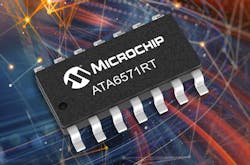
CHANDLER, Ariz. – Microchip Technology Inc. in Chandler, Ariz., is introducing the ATA6571RT radiation-tolerant CAN FD transceiver to ensure reliable and efficient data transmission in real-time control, systems integration, and enhanced error detection in space.
These radiation-tolerant transceivers support scalable designs and contribute to redundancy and fault tolerance, and offer flexible data rates as fast as 5 megabits per second in satellites and spacecraft.
The ATA6571RT transceiver supports payloads as large as bytes per frame, and is backward compatible with classic CAN, and offers a cyclic redundancy check for enhanced error detection.
On-board computers
Space applications include data handling, propulsion system control, sensor bus control, robotics, and on-board computers for nanosatellites. It remains pin-distribution compatible with original versions.
The ATA6571RT transceiver resists the effects of single-event effects (SEE) and total ionizing dose (TID), and features low power management with local and remote wake-up support, as well as short-circuit and overtemperature protection.
For more information contact Microchip Technology online at www.microchip.com/en-us/product/ATA6571RT.