Military researchers ask industry for radar-processing algorithms that overcome Arctic noise
Key Highlights
Questions and answers:
- What is the main goal of DARPA’s Frosty program? To develop new long-range radar techniques to detect, track, and identify crewed and uncrewed aircraft and surface ships in the Arctic regions, despite challenging ionospheric and noise conditions.
- How does the Frosty program plan to overcome Arctic signal disturbances? It will use advanced spatial and temporal processing algorithms to filter out random modulations caused by the disturbed ionosphere, improving radar signal clarity and detection accuracy.
- What is the timeline and structure of the Frosty program? The 33-month program has two phases: an initial 18-month period for algorithm development and testing, followed by a 15-month period focused on system integration and field testing.
ARLINGTON, Va. – U.S. military researchers are asking industry to develop new radar techniques to detect, track, and identify crewed and uncrewed aircraft and surface ships at long ranges in the Arctic regions of Northern Canada, Greenland, Scandinavia, and Russia.
Officials of the U.S. Defense Advanced Research Projects Agency (DARPA) in Arlington, Va., issued a program solicitation (DARPA-PS-26-03) on Tuesday for the Frosty program to detect aircraft and ships operating in the Arctic.
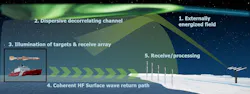
The Frosty program will develop low-power over-the-horizon sensing methods and algorithms to cover the Arctic by using forward-deployed radar receive arrays and illumination sources emitted or reflected from the Arctic ionosphere for radar sensing.
The ionosphere in the Arctic is disturbed due to the solar wind interacting with the Earth's upper atmosphere. Frosty seeks to develop ways to filter-out the RF effects of severe random modulations by a disturbed ionosphere to enhance radar signals in the Arctic.
Arctic noise problem
This program will develop radar techniques that ambient endogenous noise to create passive ambient-noise radar and demonstrate its use in Arctic regions subject to auroral oval noise.
Frosty seeks to develop spatial and temporal processing algorithms because standard radar processing is not likely to provide enough system gain for a useful radar system that works in Arctic noise; it must correct for amplitude, phase, and angle-of-arrival fluctuations from auroral turbulence. The goal is to develop signal processing flow from baseband receiver samples to detect and track test targets.
The primary focus is on developing advanced processing techniques to use the noise-like waveforms that result when illumination passes through the turbulent ionosphere to detect and track targets. Gain through advanced processing will be necessary.
Long-range detection
Frosty envisions using energy propagated through a possibly turbulent medium to detect and track targets. The key technical question is whether resulting noise-like signals will be sufficient for long-range detection and track. Goals include a minimum detection range of 47 miles; and 90 percent probability of detection and tracking.
The 33-month Frosty programs has two phases -- an 18-month period of algorithm development; offline implementation; and testing -- and a 15-month period of development, integration and field testing.
Companies interested should submit five-page abstracts as .zip files no later than 30 Jan. 2026 to the DARPA BAA Tool online at https://baa.darpa.mil. Companies that submit promising abstracts may be invited to participate in oral presentations. More information is online at https://sam.gov/workspace/contract/opp/b4b09ed37e56474285444a1792a3d70e/view.
