Matrix Research to use artificial intelligence (AI) for combat identification and decision making
Key Highlights
Questions and answers:
- What is the purpose of the U.S. Air Force’s CATCH project? To develop advanced combat identification software using AI and sensors to detect, classify, and identify targets quickly and accurately in air-to-air and air-to-ground missions.
- Which company received the CATCH project contract, and for how much? Matrix Research of Dayton, Ohio, received a $15 million contract from the Air Force Research Laboratory’s Sensors Directorate.
- How does CATCH improve target recognition and reduce errors? CATCH fuses data from multiple sensors—like radar, infrared, and lidar—and applies machine learning to identify objects, rank threats, and support human decision-making while avoiding misidentification or deception.
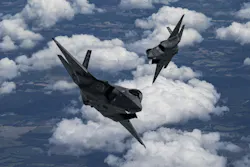
WRIGHT-PATTERSON AFB, Ohio – U.S. Air Force researchers needed new ideas in air-to-air and air-to-ground combat identification for F-16 and F-15 combat jets. They found a solution from Matrix Research in Dayton, Ohio.
Officials of the Sensors Directorate of the Air Force Research Laboratory at Wright-Patterson Air Force Base, Ohio, announced a $15 million contract to Matrix Research earlier this month for the Combat Identification Automated Target Recognition Technology (CATCH) project.
Matrix Research will explore the next generation of combat identification software algorithms to improve today's combat identification performance. Work will include single- and multi-platform combat identification research in relation to fielded systems.
Air-to-air combat identification development will be through feature fusion engines in joint multi-platform advanced combat identification (JMAC), and will include any new or promising air-to-ground combat identification ideas that warrant exploration.
Sensors and AI
CATCH essentially is about using sensors and artificial intelligence (AI) to detect, classify, and identify objects automatically in combat environments, fast enough to support real-time decisions and reduce mistakes.
CATCH aims to answer three critical questions automatically: is it a tank, truck, drone, human, decoy, terrain feature; is it friendly, enemy, neutral, or unknown; and is it relevant or threatening?
CATCH will fuse data from several different kinds of sensors, such as visible-light or infrared cameras, radar, lidar, acoustic sensors, and signals intelligence (SIGINT). The project assumes that no single sensor works well in all conditions, like fog, smoke, nighttime darkness, or electromagnetic clutter.
The project will use AI, machine learning, and deep learning based on massive labeled data sets to detect patterns in shapes, heat signatures, movement, and behavior. The goal is to distinguish quickly between friendly, enemy, and civilian objects.
Ranking threats
CATCH sensor processing seeks to rank the importance of potential threats, why an object matters, and to keep a human involved in decision making to help avoid mistakes.
The technology is expected to help reduce fratricide; work quickly; avoid deception from camouflage, decoys, and spoofing; and help human operators trust it without relying on it for mission- and life-critical decisions.
Enabling technologies developed from the CATCH project could be used with crewed and uncrewed aircraft, satellites, ground vehicles, naval ships and submarines, and perimeter-security facilities. For more information contact Matrix Research online at www.matrixresearch.com, or the Sensors Directorate of the Air Force Research Laboratory at www.afrl.af.mil/RY.
