Pentagon picks 24 companies for 3D printing and additive manufacturing of military replacement parts
Key Highlights
Questions and answers:
- What is the purpose of the Joint Additive Manufacturing Acceptability IV (JAM-A IV) program? To accelerate the qualification and deployment of 3D-printed parts for U.S. military aircraft, ships, vehicles, and other equipment by developing certification processes and validating additively manufactured components for operational use.
- How will the program help improve military logistics and readiness? By enabling on-demand production of replacement parts through additive manufacturing, the program seeks to reduce supply-chain delays, replace obsolete or hard-to-find components, and allow expeditionary manufacturing closer to where military forces operate.
- What kinds of components are expected to be produced through the JAM-A IV pilot parts program? Plastic intake caps, structural brackets, sensor mounts, mechanical housings, hangar door proximity switch brackets, and boresight and alignment components for the M320 grenade launcher.
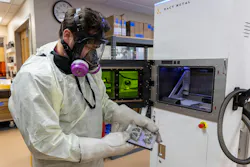
PHILADELPHIA – U.S. military systems maintenance experts are choosing 24 companies to accelerating the qualification and fielding of parts from 3D printing in military aircraft, ships, vehicles, and other equipment.
Officials of the U.S. Defense Logistics Agency in Philadelphia announced a collective $9.8 million contract to 24 companies on Thursday to provide a Joint Additive Manufacturing Acceptability IV (JAM-A IV) pilot parts program.
JAM-A IV seeks to accelerate the qualification and fielding of 3D-printed (additively manufactured) parts for military aircraft, ships, vehicles, and other equipment.
Companies doing the work
Companies chosen are:
AForge LLC in Lorton, Va.;
Alloyed Inc. in Seattle;
Applied Rapid Technologies Co. Inc. in Fredericksburg, Va.;
Colibrium Additive Cornerstone Research Group (CRG Defense) in Miamisburg, Ohio;
DMG MORI Federal Services Inc. in Hoffman Estates, Ill.;
FasTech LLC in Danville, Va.;
Form Alloy Technologies Inc. in Spring Valley, Calif.;
ITL LLC in Hampton, Va.;
KVG LLC in Gettysburg, Pa.;
Lift Technologies in Detroit.;
Malama Kai Technologies LLC in Herndon, Va.;
Maritech Machine Inc. in Panama City, Fla.;
Marotta Controls Inc. in Montville, N.J.;
MRL Materials Resources LLC in Xenia, Ohio;
MXD USA in Chicago;
NCS Technologies Inc. in Manassas, Va.;
Nikon AM Synergy Inc. in Long Beach, Calif.;
Precision Additive Solutions Inc. in Indianapolis;
Relativity Space Inc. in Long Beach, Calif.;
Shepra Inc. in Orange Park, Fla.;
Sintavia LLC in Hollywood, Fla.;
Stratasys Direct Inc. in Eden Prairie, Minn.; and
Velo3D Inc. in Fremont, Calif.
3D printed replacement parts
The program is designed to qualify additively manufactured military replacement parts for important systems; reduce supply-chain delays by allowing parts to be produced quickly via additive manufacturing; develop standards and certification processes so 3D-printed components can be accepted for use on critical defense systems; and create a digital inventory of validated parts that can be manufactured on demand.
This is the fourth phase of the broader Joint Additive Manufacturing Acceptability (JAM-A) program, which focuses on establishing engineering, testing, and certification for 3D printing across the U.S. military.
The pilot parts effort identifies specific legacy components suitable for additive manufacturing. Then the project will digitize or reverse-engineer the part; print prototype versions using approved AM processes; test and validate mechanical properties and performance; and certify the parts for military use.
Typical candidate parts include obsolete components that original manufacturers no longer produce; low-volume replacement parts; and complex components that benefit from additive manufacturing.
Production close to users
The project also focuses on expeditionary manufacturing to produce parts close to where forces operate; shrink spare-parts inventories; offer fast maintenance turnaround for aircraft and ships; and improve readiness for aging systems with hard-to-find components.
Typical 3D printing technologies involve laser powder bed fusion; directed energy deposition; binder jetting for metals; and polymer additive manufacturing.
The project will involve parts and systems like plastic intake caps; boresight components for the M320 grenade launcher; a precision alignment device used with the M320 grenade launcher; hangar door proximity switch brackets; pressurized door seals; structural brackets; mechanical housings; sensor mounts; and small mechanical components for ground equipment.
Parts that cause readiness delays
These parts represent typical logistics items that frequently cause readiness delays, such as obsolete, low-volume, or long-lead-time components. Demonstrating that these can be 3D-printed reliably can enable the military to print spares on demand rather than store large inventories.
These are one-year base contracts with four one-year option periods, and the companies involved should be finished by February 2027. Work primarily will be for the U.S. Army, Navy, Air Force, Marine Corps, Department of Defense, and Defense Logistics Agency.
For more information contact the Defense Logistics Agency Contracting Services Office online at https://www.dla.mil/Small-Business/Resource-Center/Training-Resources/Details/Article/4161623/contracting-services-dla-contracting-services-office-dcso/.
