Designing for the extreme edge: Engineering small-form-factor mission systems with VITA 90 VNX+
Key Highlights
- The architecture incorporates high-density RF, optical, and digital interfaces, facilitating complex sensor and communication integration in small spaces.
- Open standards like VITA 90 VNX+ promote interoperability, modularity, and long-term maintainability across diverse defense systems and platforms.
- Design considerations include thermal management, signal integrity, and power distribution, essential for reliable operation in harsh environments.
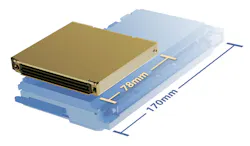
LISLE, Ill. - For decades, advances in military electronics meant adding capability to the platforms that carried them. Today, many of the fastest advances in defense electronics are taking place within the payloads themselves. Electronic warfare suites, software-defined radios, autonomous platforms, and intelligence, surveillance, and reconnaissance (ISR) sensors must capture, process, and exploit growing volumes of data locally, often within form factors where every cubic centimeter, watt, and gram matter.
Edge computing is changing the design priorities for embedded mission systems. Processing performance continues to improve, but processor selection is no longer the primary design challenge. Modern embedded systems must also accommodate higher data rates, greater power densities and more demanding thermal loads. Whether deployed on a small, unmanned aircraft, integrated into a ground vehicle or carried by a soldier, embedded computing platforms are expected to deliver more performance from a significantly smaller footprint.
Designs must reflect the competing needs of ever-shrinking platforms. Higher-bandwidth sensors may require additional processing, but they also increase demands on high-speed interconnects, power distribution and thermal management. Integrating radio frequency (RF) capabilities, optical interconnects, or field-programmable gate array (FPGA) acceleration adds further complexity, while the need for ruggedization leaves little opportunity to solve problems by increasing enclosure size or adding cooling capacity.
In these environments, the movement of information through the system becomes just as important as the processing itself. Transmitting data reliably between sensors, processors, and communications interfaces requires engineers to balance competing factors. Signal integrity, latency, power consumption, and thermal loading all become closely linked, meaning decisions about the interconnect architecture can directly influence overall system performance.
The challenge, therefore, is no longer one of miniaturization alone. Designers must integrate hybrid signaling (RF/optical/power) into rugged, small-form-factor embedded systems that remain reliable throughout long operational service lives. They must also ensure these systems can accommodate changes in processing technologies, sensors and mission requirements.
Meeting those objectives demands more than miniaturization. Computing, data movement, power delivery and thermal management are all part of the same engineering problem. These demands are driving the development of new open architectures for embedded computing. VITA 90 VNX+ extends modular open systems principles into applications where high-performance processing must coexist with RF, optical interconnects, power delivery, and thermal management within an exceptionally compact footprint.
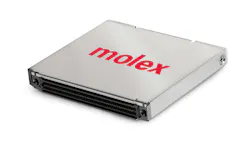
Molex VNX+ Processing Module Concept, illustrating a compact processing module designed around the VITA 90 VNX+ form factor.
Why Smaller Systems Need a Different Architecture
The growing demand for edge processing does not diminish the value of established embedded computing standards. VPX, based on the VITA 46 family of specifications, has become the foundation for many high-performance defense computing platforms. Its combination of modularity, ruggedness, and high-speed data transport has enabled successive generations of mission computers to keep pace with increasing processing requirements.
Today's embedded mission systems present a different set of engineering constraints. Traditional VPX systems were designed for applications where engineers could accommodate larger cards, robust cooling and relatively generous power budgets. While those limitations were never insignificant, they provided greater flexibility when integrating processors, storage, networking, and RF subsystems into a single platform.
Small-form-factor mission systems operate under very different conditions. Mission processing capabilities that were once concentrated within larger platforms are increasingly being distributed across unmanned aircraft, guided weapons, smart munitions and other systems operating at the tactical edge. These trends are driving demand for compact embedded computing architectures. An electronic warfare payload, for example, may need to perform wideband RF digitization and real-time signal processing within a package measured in only a few liters. Similar demands are emerging in portable communications equipment and autonomous ground systems.
They are also evident in space, where CubeSats and other low Earth orbit platforms must combine processing, communications, and sensor interfaces within severe volume and power constraints while operating without conventional airflow cooling. VITA 90.5 (SpaceVNX+) extends the architecture to address these space-specific design considerations. Across these applications, scaling down established architectures is only part of the solution. Every connector, board, and watt must justify the space it occupies.
Size and weight constraints have implications beyond mechanical packaging. Higher circuit densities increase thermal loading, while shorter electrical paths and tighter layouts demand careful attention to signal integrity. Designers must also accommodate a growing mix of electrical, optical and RF interfaces as systems combine more functions within the same compact platform. Interconnects are no longer only responsible for carrying signals between modules. They play a central role in determining the overall performance, reliability and serviceability of the platform.
These changing requirements led the VITA community to develop the VITA 90 VNX+ standard, extending the benefits of modular open architectures into applications where traditional VPX implementations may no longer be practical. Rather than focusing solely on miniaturization, VNX+ was designed to support the combination of high-speed digital communications, RF connectivity, optical interconnects, power distribution, and system management needed for the next generation of compact embedded computing platforms.
Although VNX+ builds on concepts established by VITA 74 and the wider VPX ecosystem, it is a new architecture optimized for substantially higher performance and richer I/O rather than a backward-compatible update.
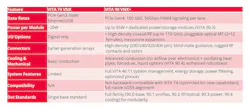
VITA 90 VNX+ advances the VITA 74 VNX specification with higher performance, expanded I/O, greater power and thermal capabilities, and open-standard interoperability.
A High-Performance Framework for Mission-Critical Environments
VITA 90 VNX+ is an open standard for rugged, small-form-factor embedded computing that extends the modular principles established by VPX into applications with much tighter size, weight, and power (SWaP) constraints. Earlier VNX implementations typically supported PCIe Gen3 and power budgets of around 20 W per module. VNX+ raises that ceiling to as much as 95 W while supporting PCIe Gen4, 100 GbE, and 56 Gbps PAM4 signaling per lane. It also expands the available I/O beyond digital interfaces, with provisions for high-density RF connectivity and pluggable optical modules. These changes bring substantially greater processing and data-movement capability into the same small-form-factor design space.
VNX+ is supported by a family of “dot standards” that separate the architecture into clearly defined functional areas. VITA 90.1 covers slot profiles, while VITA 90.2 addresses optical and coaxial interfaces. VITA 90.3 defines power-conversion and energy-storage modules, and VITA 90.4 addresses mounting, retention and thermal management. VITA 90.5 extends the framework to space applications, including the particular constraints encountered by CubeSats and other systems operating in low Earth orbit.
The significance of VNX+ therefore lies not solely in its physical dimensions, but in the engineering capabilities it enables. The architecture integrates multiple technologies within a rugged, small-form-factor environment to directly solve SWaP constraints. This allows system designers to shrink platforms without abandoning the modularity, interoperability and long-term maintainability central to modern defense acquisition strategies.
Beyond the Connector
Modern mission systems increasingly combine technologies developed by multiple specialist suppliers within the same enclosure. No single supplier can realistically provide every element of the system, making common mechanical and electrical interfaces essential. Open standards allow these independently developed technologies to operate together within a shared modular platform.
VITA 90 VNX+ provides the common architecture that enables this interoperability while supporting independent technology development. System integrators can select the components best suited to a particular application without sacrificing compatibility or long-term maintainability.
For equipment manufacturers, this creates opportunities to focus on innovation within their own areas of expertise while contributing to a wider ecosystem. New technologies can be introduced without requiring fundamental changes to the underlying system. The result is a platform that is smaller, more capable, and easier to upgrade as technologies evolve.
Beyond the Platform
Open architectures make embedded systems easier to adapt to changing requirements. While aircraft, ships, and ground vehicles may remain in service for decades, the processing, RF, and networking technologies they rely upon can become obsolete within only a few years. Common standards help bridge that mismatch by allowing capabilities to be upgraded without redesigning entire platforms.
This philosophy aligns closely with initiatives such as the Modular Open Systems Approach (MOSA) and the Sensor Open Systems Architecture (SOSA™) Consortium, which reduce dependence on proprietary designs while encouraging competition and interoperability. By defining common interfaces, open standards allow new processing, RF and networking technologies to be introduced while reducing life-cycle costs and accelerating capability refreshes.
An open architecture only delivers those benefits when supported by a broad ecosystem of technology providers. No single organization can realistically provide every element of a modern computing platform. The development of VITA 90 VNX+ reflects that reality, bringing together companies with expertise in embedded computing, connectors, RF engineering and system integration to create an open architectural foundation for future programs.
For Molex, this represents a broader evolution within the embedded computing industry. Alongside its heritage in connector and related system technologies, the company now contributes technologies spanning electrical, optical and RF interconnects for next-generation embedded computing platforms. This broader portfolio reflects the fact that modern embedded systems depend on multiple engineering disciplines rather than any single component technology.
As mission platforms continue to evolve, the ability to integrate advances across multiple engineering disciplines within a common architecture will become increasingly important. The long-term value of VITA 90 VNX+ therefore lies not solely in enabling smaller embedded computers, but in providing an open foundation on which future platforms can continue to evolve as processing, sensing, and communications technologies advance.
