Resolving [HD1.1]Navigational Drift with Tactical MEMS IMUs in AGVs
Key Highlights
- AGVs are transforming military logistics and reconnaissance by operating autonomously in complex, GNSS-denied environments.
- Choosing the right IMU is crucial; tactical-grade MEMS units offer a balance of size, cost, and stability suitable for demanding terrains.
- Sensor fusion, combining IMU data with LiDAR and odometry, is essential for maintaining accurate navigation when satellite signals are unavailable.
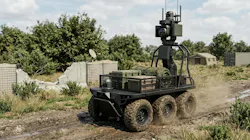
Autonomous Ground Vehicles (AGVs)[HD1] are redefining logistical resupply, tactical reconnaissance, and many more operations in modern combat scenarios. While removing human operators from harm's way, these platforms can autonomously navigate unpredictable terrain in contested environment. However, their success is entirely dependent on continuous precise self-localisation. If an AGV loses track of its exact coordinates, it cannot execute its mission, avoid obstacles, or safely return to base.
Unlike aerial platforms that move through relatively uniform airspace, AGVs operate in unpredictable, highly dynamic environments that are often denied from GNSS signals, such as dense forest canopies, deep valleys, and urban canyons. When satellite signals are unavailable or actively jammed on the frontline, the AGV's navigation computer must rely on dead reckoning, combining data from wheel odometry, LiDAR, or optical flow with an inertial measurement unit (IMU).
For integration engineers, this land environment presents severe technical hurdles. Ground vehicles endure constant, high-amplitude shocks from rough terrain, sustained vibrations from the vehicle's tracks, and in some domains, extreme temperature fluctuations. Commercial-grade IMUs under these forces can suffer from severe bias drift; over just a few hundred meters of travel, these sensor errors compound, leading to positioning drift that misleads the vehicle's path-planning software, taking them off-course.
Choosing the Right IMU for Navigation in Denied Environments
This is where the choice of IMU for navigation becomes the decisive design factor. For decades, the only way to control drift was to fit large, expensive fibre-optic or ring-laser gyroscopes. These instruments have excellent bias stability, but with the size, weight, power draw, and cost profile that made them impractical for smaller autonomous platforms produced at scale. The alternative, commercial-grade MEMS (Micro-Electro-Mechanical Systems) IMUs, solved the size and cost problem but historically lacked the bias stability to survive sustained shock and vibration without drifting off-course.
Tactical MEMS IMUs close this gap. By combining MEMS fabrication with stricter manufacturing tolerances and calibration across temperature ranges these units deliver bias stability and noise performance approaching that of legacy fibre-optic systems, at a fraction of the size, weight, and cost. For AGV integration engineers, this means the vehicle can sustain trustworthy dead reckoning over critical phases of the mission, regardless of GNSS denial, jamming, or the shock loading of the vehicle’s movement.
Why an IMU for Navigation Can't Work Alone
No single sensor, however capable, can be trusted in isolation. A tactical-grade IMU for navigation dramatically slows the rate of positional drift but doesn't eliminate it; left to integrate alone over time, even the best MEMS unit will accumulate error. The real gain comes from fusing the IMU with the AGV's other sensing apparatus.
When GNSS is available, an IMU acts as ground truth for periodic correction. When it drops out, the system leans more heavily on the IMU, LiDAR, and odometry combination with the tactical-grade IMU doing the heavy lifting of bridging position estimates until GNSS returns. It's this fusion, rather than a single sensor's performance, that determines whether an AGV can maintain navigation through a fully denied environment.
Conclusion
Choosing the right IMU for navigation is one of the most consequential decisions an AGV integration engineer will make. Lower-grade IMUs can be partially propped up by a well-designed fusion architecture, but only by leaning more heavily on other sensing methods. A tactical-grade MEMS unit removes that fragility. It delivers the bias stability and shock resistance needed to bridge GNSS-denied stretches on its own merit, rather than relying on the rest of the stack to compensate for it at a fraction of the size, weight, and cost of a navigation-grade alternative. For engineers building AGVs that need to operate reliably in contested, GNSS-denied environments, tactical-grade MEMS isn't just one option among several it's the sensible baseline the rest of the navigation stack should be built around.
[HD1]https://www.belfercenter.org/research-analysis/road-ahead-unmanned-how-autonomous-ground-vehicles-can-transform-warfighting-0