How Laser Power Beaming Enables In-Flight UAV Charging
For an uncrewed aerial vehicle (UAV), staying in the air longer usually means carrying a larger battery. However, a bigger battery adds weight, which can limit how much equipment the aircraft can carry. Solar power can help, but it depends on weather conditions and the amount of available sunlight. At some point, the aircraft encounters a simple yet challenging constraint: A UAV can carry only a limited amount of onboard energy.
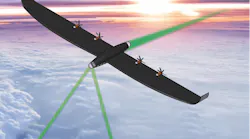
One approach engineers are using to address this challenge is laser power beaming. In this technique, a ground-based laser beam delivers energy to photovoltaic cells on the UAV, allowing it to recharge while remaining in flight. While the concept dates back to the 1960s, several recent tests suggest it is getting closer to practical implementation.[1]
Researchers are working to improve the efficiency of lightweight receivers designed to convert laser energy into electricity aboard UAVs. The US Naval Research Laboratory (NRL) has tested laser power beaming under real-world field conditions. And wireless power technology company PowerLight Technologies has also been working with a fixed-wing UAV, autonomously tracking the aircraft and delivering power to it during flight.[2]
These independent efforts together raise a broader question about UAV endurance. Instead of focusing solely on how much more energy engineers can store onboard, it may be equally important to consider how energy can be delivered to the aircraft while it is operating.
Powering a UAV in Flight
Tom Nugent, co-founder and chief technology officer (CTO) of PowerLight Technologies, describes laser power beaming as a “wireless extension cord” into the sky. The comparison makes the idea sound simple, but building that extension cord requires several technologies to work together. The laser must deliver sufficient energy over distance, the beam must remain aligned with a moving aircraft, and the receiver must convert the incoming light into useful electrical power without adding excess weight or heat.
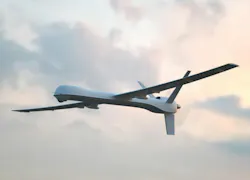
PowerLight has been testing its Aerial ReCharge™ system with Kraus Hamdani Aerospace’s K1000ULE fixed-wing UAV (Figure 1). During flight, the system tracks the aircraft and directs the laser toward photovoltaic cells tuned to the laser's wavelength. Conventional solar cells are designed to convert a broad spectrum of sunlight, whereas these cells receive a specific wavelength of near-infrared light, allowing them to convert the incoming energy more efficiently. The current system is designed to deliver power at distances of up to 1.6km (1mi).
Sources
[1] https://www.nasa.gov/wp-content/uploads/2023/06/newsnotes-40-2.pdf?emrc=6984966f062d3
[2] https://powerlighttech.com/powerlight-wireless-power-beaming-drone-test-geekwire/
[3] https://www.sciencedirect.com/science/article/pii/S3117584826000669
[4] https://www.nrl.navy.mil/Media/News/Article/4518270/nrl-demonstrates-dual-use-laser-system-for-power-beaming-and-counter-uas-operat/
[5] https://powerlighttech.com/powerlight-technologies-ships-5g-prototype
[6] https://powerlighttech.com/plt-blue-origin-luna-10-team/
Author
Nicolette Emmino is a technology writer and editor with over 15 years of experience covering electronics, engineering, and emerging technologies. Her work focuses on translating complex topics into clear, accurate storytelling for engineering audiences. She collaborates closely with engineers and subject-matter experts on editorial development and also co-leads engineering-focused media companies.