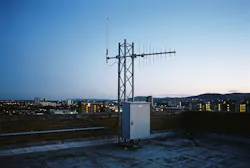
Wide-area spectrum monitoring with automated classification
ABSTRACT
Monitoring systems increasingly hand the identification problem to a trained model: sweep the band, detect every emitter, capture the unknowns as IQ, and let a classifier name them. This paper derives why a swept receiver
cannot supply that classifier with complete data, quantifies what gap-free capture guarantees instead, works the storage arithmetic that forces a triggered architecture, and shows through the data processing inequality that no model can recover what the capture destroyed.
WHO THIS PAPER IS FOR
Monitoring and SIGINT system architects designing a survey-to-identification pipeline. Machine learning engineers working on RF classification who need to know what the front end does to their data. Regulators and spectrum managers specifying monitoring equipment.
KEY RESULTS

The problem with sweeping a wide band
Spectrum monitoring used to end at detection. An operator saw an unknown carrier, wrote down a frequency, and went looking for someone who could say what it was. The systems being built now are asked to answer that question themselves, and they answer it with a trained model.
That changes what the receiver is for. It is no longer a display feeding a human; it is a sensor feeding a statistical estimator, and the estimator inherits every property of the data it is given. The question this paper asks is therefore not how fast an analyzer can sweep, but whether what it produces is fit to train on.
A faster sweep is the first remedy to consider, and its limit is set here because everything after depends on it. The fraction of each pass spent inside any one resolution cell is RBW divided by span, and that fraction does not depend on how fast the pass is. A receiver that sweeps twice as fast revisits sooner and hears less each time, in the proportion that leaves the product unchanged. The quantity that decides what a monitoring system sees is how much of the band is being listened to at once, and sweep speed does not move it.
Start with the sweep itself. A swept receiver moves a fixed intermediate-frequency filter across the span. That filter is a physical resonator with a settling time of roughly the reciprocal of its bandwidth, and the signal is inside it for only the fraction of the sweep given by the ratio of resolution
bandwidth to span. Requiring the filter to settle gives the classical relation:
Tsweep ≈ k · S / RBW2
where
S the span, in hertz; 40 GHz in the worked cases
RBW the resolution bandwidth, in hertz
k a filter shape constant, roughly 2 to 3 for a near-Gaussian
filter; 2 below
The resolution bandwidth appears squared for two reasons at once, and this is the structural fact to carry. Halving it doubles the number of resolution cells to visit, and it also doubles the settling time in each one. The two effects multiply.
Table 1 works that through for a full-span survey at five resolution bandwidths, with the cell count that drives each row.
