EW & SIGINT
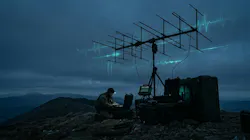
Electronic warfare and signal intelligence work lives at the edge of the spectrum. The emitters that matter are often short,agile, and deliberately hard to find. A frequency-hopping radio dwells on a channel for milliseconds. A radar pulse may last afraction of a microsecond and then go quiet. A drone control link can appear, move, and disappear before a slow analyzerfinishes a single sweep. The operator does not get a second look.
That puts three demands on the instrument at once. It has to see a wide slice of spectrum without scanning, so nothing slipsthrough between sweeps. It has to capture and characterize a signal fast enough to read its structure: center frequency,modulation, and the pulse parameters that fingerprint a radar. And it has to do all of this in the weather, far from a lab bench,in something a team can carry.
The harder problem is interpretation. Detecting energy is the first step. Knowing what the energy is, fast enough to act, is thejob. Pulse parameters, demodulation, and a clean record of the raw signal are what turn a detection into intelligence.
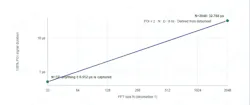
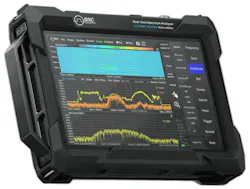
The ICX-FieldHawk receivers are built around wide real-time bandwidth, so the instrument watches a large span continuouslyrather than stepping through it. The density display reveals the faint, the brief, and the intermittent: signals that a sweptanalyzer would miss between passes. Anything that lasts at least the guaranteed duration, 0.512 μs at the shortesttransform, is captured in full.
On top of that live view, the SpectraCore software adds Pulse Detection as option 72. Its table lists each pulse’s top and baselevel, rise and fall time, width, repetition interval and duty cycle, with the minimum, maximum and mean PRI and width acrossthe record. For pulsed emitters and radar work, that is the difference between seeing a flash and reading a signature. DigitalDemodulation (option 71) covers 2ASK, 2FSK, 4FSK, GMSK, BPSK, QPSK, 8PSK and 16 to 256 QAM, so an operator canmove from detection to identification on the same screen.