Detecting unmanned aircraft, and finding the operator
ABSTRACT
Radio detection of small unmanned aircraft is often specified as a sensitivity problem. The arithmetic in this paper shows it to be a probability-of-intercept problem: against a burst lasting 645 microseconds once every 600 milliseconds, a scanning receiver needs about ninety seconds to reach ninety percent confidence while a gap-free receiver needs the emitter's own repetition interval. The paper derives that result, works the link budget for both ends of the link, sets out what each direction-finding method delivers, and states where radio detection is blind.
WHO IS THIS PAPER FOR
Counter-UAS system integrators designing or specifying an RF sensing layer. Security and site-protection engineers evaluating what an RF sensor can and cannot deliver. Spectrum enforcement staff working unauthorized flight cases.
KEY RESULTS

Two emitters, two geometries
A small unmanned aircraft flown over a radio link is a pair of radios. The controller sends a narrow, low-duty-cycle uplink. The aircraft returns a wide, high-duty-cycle video downlink.They occupy the same bands and belong to the same system, and for the purpose of finding the person flying they differ in every property that matters.
A scanning detector sold as a drone-band monitor is the least expensive sensor for the band, and it detects traffic. What it cannot do is report how much it missed: section 2 shows that such a receiver hears a hopping link about one percent of the time, so what it reports is a sparse and unrepeatable sample of the traffic, and an operator cannot tell a quiet sky from a missed one. Adding receivers does not change the fraction: three receivers each hearing the band one percent of the time are still hearing it one percent of the time, and the false alarms triple. The constraint is neither sensitivity nor channel count. It is coincidence, and coincidence can be computed.
Figure 1 draws the two links
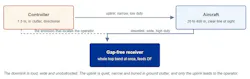
Figure 1 is the difficulty in one picture. The aircraft is in clear air with a quasi-omnidirectional antenna, transmitting tens of megahertz at high duty cycle. The controller is a meter and a half above the ground, behind whatever the ground has on it, with an antenna pointed at the aircraft rather than at the sensor, transmitting a short slot.
There is a third emission, and it is the easiest of all: the mandated Remote ID broadcast. Under ASTM F3411 and 14 CFR Part 89 a compliant aircraft transmits its identity, its position and its control station position in the clear over Bluetooth or Wi-Fi, at least once per second. The European requirement under Regulation (EU) 2019/945 is equivalent and explicitly names the remote pilot's position. That broadcast is designed to be received by anyone, and by construction it is present only on aircraft whose operators
chose to comply.