Army awards AeroVironment prototype OTA for Switchblade 400 under LASSO program
Key Highlights
- The Switchblade 400 is a lightweight, man-portable loitering munition designed for anti-armor missions, deployable by a single soldier in under five minutes.
- It features integrated electro-optical and infrared sensors with onboard processing for autonomous detection, classification, and target recognition in day and night conditions.
- The system supports interoperability through a Modular Open Systems Approach and integrates with AeroVironment’s AV_Halo command-and-control ecosystem for seamless tactical network connectivity.
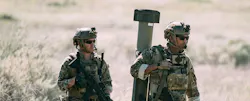
ARLINGTON, Va. - AeroVironment Inc. in Arlington, Va., has received a prototype agreement from the U.S. Army under the Low-Altitude Stalking and Strike Ordnance (LASSO) program to support development, testing, and delivery of the Switchblade 400 loitering munition, a medium-range, man-portable precision strike system designed for anti-armor missions in contested environments.
The award advances the Army’s effort to field rapidly deployable loitering munition capabilities for small-unit operations and does not include disclosed contract value or production quantities, consistent with Other Transaction Authority prototype agreements used to accelerate iterative system development.
The company described the system as a "rocket-launched, medium-range, man-portable loitering munition engineered for decisive battlefield overmatch," designed to defeat armored targets at standoff distances.
Single-soldier deployable
The Switchblade 400 is designed for launch from a self-contained tube system and can be deployed by a single soldier in under five minutes. It weighs under 40 pounds in its all-up round configuration and is intended to provide rapid-response anti-armor capability at the tactical edge.
The system integrates electro-optical and infrared sensing with onboard processing to support aided target recognition and autonomous detection and classification functions. AeroVironment said the system is designed to operate in both day and night conditions and in "denied and contested environments," with performance optimized for degraded communications and navigation conditions.
The system incorporates a Modular Open Systems Approach (MOSA) intended to support interoperability, upgradeability, and long-term adaptability across evolving mission requirements. It is also integrated into AeroVironment’s AV_Halo command-and-control ecosystem, which provides common control across multiple unmanned systems and supports integration with tactical networks, including ATAK and Net Warrior.
AeroVironment described the Switchblade 400 as the first loitering munition purpose-built to operate within the AV_Halo environment, enabling a sensor-to-shooter architecture that shortens engagement timelines while improving targeting precision at extended ranges.
The LASSO selection of the Switchblade 400 reinforces a broader shift in tactical strike systems toward tightly integrated sensing, processing, and networking at the edge, where engagement decisions are increasingly compressed into seconds and must be executed with limited or contested connectivity.
At the core of that shift is the growing importance of onboard electro-optical and infrared sensing paired with embedded compute pipelines. Systems in this class are no longer passive guidance weapons; they are, in effect, compact, mission-specific sensor-processing nodes. That means greater reliance on real-time image processing, automated target recognition, and low-latency decision logic running directly on the munition rather than being fully dependent on ground stations.
For embedded computing engineers, this drives continued adoption of SWaP-constrained architectures that combine low-power system-on-chip designs, specialized accelerators for computer vision inference, and hardened firmware for operation under intermittent communication. The emphasis is less on raw compute throughput and more on deterministic performance under latency and jamming constraints.
Eye on EW
From an electronic warfare perspective, the operating environment described for LASSO reflects increasing demand for resilient communications and navigation systems. Encrypted mesh networking, multi-path data links, and degraded-GPS operation modes point to a design space in which systems must assume partial spectrum denial as a baseline rather than an exception. That directly influences waveform design, anti-jam techniques, and frequency agility requirements in supporting datalinks.
The LASSO award follows earlier Army procurement activity under a broader loitering munition acquisition strategy that includes a five-year indefinite delivery, indefinite quantity contract valued at up to $990 million. That contract has supported delivery orders for Switchblade variants, including systems equipped with enhanced-lethality payloads for armored target engagement.
Army officials have described LASSO as part of a directed requirement to expand organic precision strike capability at the small-unit level, particularly in environments where traditional fire support may be delayed or unavailable. The program is intended to reduce engagement timelines while increasing tactical flexibility for maneuver forces.
The U.S. Army has not disclosed technical allocation details, production quantities, or specific unit fielding plans associated with the Switchblade 400 prototype effort. The program remains in early-stage development under OTA authority, with continued testing and capability refinement expected as part of the LASSO framework.
About the Author
Jamie Whitney
Editor-in-Chief
Jamie Whitney joined the staff of Military & Aerospace Electronics in 2018 and oversees editorial content and produces news and features for Military & Aerospace Electronics, attends industry events, produces Webcasts, and oversees print production of Military & Aerospace Electronics.
Related
Voice Your Opinion!
To join the conversation, and become an exclusive member of Military Aerospace, create an account today!
 Leaders Logo
Leaders relevant to this article: